
Mexico Cosmetics Market Size, Share, Latest Insights Trends and Forecast 2026-2034
IMARC Group has recently released a new research study titled "Mexico Cosmetics Market Size, Share, Trends and Forecast by Product Type, Category, Gender, Distribution Channel, and Region, 2026-2034", offering a detailed analysis of the market drivers, segmentation, growth opportunities, trends, and competitive landscape to understand the current and future market scenarios.
Mexico Cosmetics Market Size & Share 2026-2034
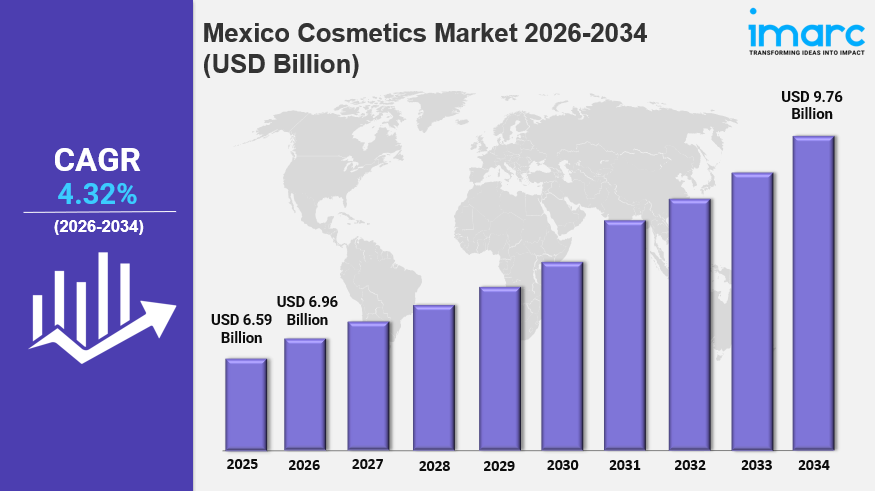
The Mexico cosmetics market grew from USD 6.59 Billion in 2025 to USD 6.96 Billion in 2026 and is projected to reach USD 9.76 Billion by 2034, expanding at a CAGR of 4.32% during 2026-2034. The market has expanded steadily from USD 5.34 Billion in 2020, shaped by rising disposable incomes, increasing urbanization, growing beauty consciousness, the influence of social media, expanding retail channels, and rising demand for organic and natural products.
The market is segmented by product type (skin and sun care products, hair care products, deodorants and fragrances, makeup and color cosmetics, and others), category (conventional and organic), gender (men, women, and unisex), distribution channel (supermarkets and hypermarkets, specialty stores, pharmacies, online stores, and others), and region (Northern, Central, and Southern Mexico, and others). Conventional cosmetics lead the category segment with an 84.3% share and women lead the gender segment with 61.5% in 2025, while Central Mexico dominates regionally with a 42.7% Mexico cosmetics market share, reflecting its large urban consumer base and high retail density.
Key Market Statistics at a Glance
- Base Year: 2025
- Historical Years: 2020-2025
- Forecast Period: 2026-2034
- Market Size (2025): USD 6.59 Billion
- Market Size (2026): USD 6.96 Billion
- Projected Market Size (2034): USD 9.76 Billion
- Growth Rate: CAGR of 4.32% (2026-2034)
Explore Opportunities in the Mexico Cosmetics Market: Download the IMARC Sample Report: https://www.imarcgroup.com/mexico-cosmetics-market/requestsample
Key Growth Drivers and Trends in the Mexico Cosmetics Market
Growth in the Mexico cosmetics market is being driven primarily by rising disposable incomes and the expansion of the urban middle class. Major metropolitan areas such as Mexico City, Monterrey, and Guadalajara have seen consistent gains in household income, enabling more spending on discretionary personal care products. According to Mexico’s National Institute of Statistics and Geography (INEGI), the urban population exceeded 80% of the total population by 2024, widening the addressable market, while higher incomes have shifted preferences toward premium and imported beauty brands.
One of the leading Mexico cosmetics market trends is the influence of social media and digital commerce on purchase behavior. Instagram, TikTok, YouTube, and Pinterest are reshaping product discovery among millennials and Gen Z, and internet penetration reached 83.5% of a population of roughly 132 million by late 2025 and into 2026, with mobile as the primary access point. TikTok Shop and Instagram Shopping integrations, live-streamed beauty tutorials, and digital payments such as OXXO Pay, SPEI transfers, and Mercado Pago are shortening the path from inspiration to purchase, while AI skin analysis and augmented reality virtual try-on tools are improving personalization.
Another key factor supporting Mexico cosmetics market growth is demand for organic, natural, and clean beauty products and the growth of male grooming. Organic cosmetics held a 15.7% share in 2025 and are projected to grow at approximately 5.8% CAGR through 2034, outpacing the overall market, as consumers scrutinize ingredient lists and prioritize cruelty-free, vegan, and sustainably sourced products. Men accounted for 22.8% of the market in 2025, with male grooming growing at approximately 4.9% CAGR as major brands extend skincare, hair styling, and beard care lines for men.
Speak to an Analyst: https://www.imarcgroup.com/request?type=report&id=33949&flag=C
Mexico Cosmetics Industry Segmentation Insights
Breakup by Product Type:
- Skin and Sun Care Products: The largest product type, covering facial and body skincare, anti-aging, dermocosmetic, and SPF products, supported by demand for ingredients such as retinol, hyaluronic acid, peptides, and niacinamide.
- Hair Care Products: Shampoos, conditioners, treatments, and hair color that maintain consistent demand across demographics; brands include Pantene, Head & Shoulders, TRESemmé, and Garnier.
- Deodorants and Fragrances: Personal fragrance and deodorant products sold across mass and premium channels, with male grooming a growing contributor.
- Makeup and Color Cosmetics: Lipstick, foundation, eye shadow, and related products that benefit from social media beauty trends and AR virtual try-on tools.
- Others: Includes other personal care and beauty products not covered in the categories above.
Breakup by Category:
- Conventional: Held an 84.3% share in 2025, driven by broad accessibility, affordable pricing, established brand trust, and extensive retail availability across all channels.
- Organic: Held a 15.7% share in 2025 and is the faster-growing category at approximately 5.8% CAGR, fueled by awareness of ingredient safety, sustainability, and clean beauty trends.
Breakup by Gender:
- Women: The largest segment at 61.5% in 2025, with consistent spending on skincare, haircare, makeup, and fragrances, amplified by social media beauty trends and cultural beauty norms.
- Men: Accounted for 22.8% in 2025, growing at approximately 4.9% CAGR as grooming awareness rises and brands launch targeted product lines.
- Unisex: Accounted for 15.7% in 2025 and is growing at approximately 5.2% CAGR through gender-neutral formulations, packaging, and inclusive marketing.
Breakup by Distribution Channel:
- Supermarkets and Hypermarkets: Large-format retail offering wide availability of mass-market cosmetics across urban and semi-urban Mexico.
- Specialty Stores: Beauty-focused retailers such as Sephora and MAC that serve premium and prestige demand, particularly in major cities.
- Pharmacies: An increasingly important premium channel for dermocosmetics, supported by trained staff who provide product education and recommendations.
- Online Stores: Platforms such as Mercado Libre, Amazon Mexico, and brand-owned D2C websites; e-commerce is estimated to grow at approximately 8-10% CAGR.
- Others: Includes department stores and direct-selling networks, such as Avon and Mary Kay, that remain strong among cost-sensitive and semi-urban consumers.
Breakup by Region:
- Central Mexico: The leading region with a 42.7% share in 2025, anchored by Mexico City’s high retail density, premium brand penetration, department stores, and Sephora and MAC flagship locations.
- Northern Mexico: Held a 28.4% share, supported by industrial activity, cross-border trade with the United States, and consumers in Monterrey and Tijuana with high disposable incomes.
- Southern Mexico: Held a 17.1% share and is seeing the fastest regional growth momentum as urbanization accelerates, retail infrastructure improves, and direct-selling networks expand.
- Others: Held an 11.8% share, covering the Bajío, Pacific Coast, and Gulf Coast regions, driven by industrial growth and expanding urban populations in secondary cities.
Key Challenges and Growth Opportunities in the Mexico Cosmetics Market
The Mexico cosmetics market faces pressure from counterfeit and low-quality products sold through informal channels, which erode brand equity and consumer trust; COFEPRIS regularly issues alerts on unregistered cosmetic products. Compliance with COFEPRIS requirements on product notification, ingredient safety, and labeling can delay launches, particularly for smaller brands. Currency volatility also matters, as many ingredients and finished products are priced in USD, so peso fluctuations affect import costs, margins, and retail prices. Competition from multinationals and reliance on imported active ingredients and packaging add further cost and supply chain uncertainty.
The market offers considerable growth opportunities in e-commerce and direct-to-consumer channels, premiumization and anti-aging skincare, male grooming, organic and clean beauty, and sustainable packaging. In October 2024, e.l.f. Cosmetics launched in Sephora Mexico, and in November 2024, Givaudan doubled the encapsulation technology capacity of its Pedro Escobedo facility in Mexico. Proximity to the United States and USMCA trade advantages also support local manufacturing investment, as seen in Unilever’s USD 400 million facility investment in Nuevo León, which are expected to create further opportunities through 2034.
Competitive Landscape
The Mexico cosmetics market is moderately concentrated at the top, with five multinationals holding approximately 50% of retail value sales according to industry sources, while the remainder is spread across regional players, direct-selling brands, specialty labels, and domestic manufacturers. Competition centers on product innovation, digital engagement, influencer partnerships, and omnichannel distribution. Key players include L’Oréal S.A., Unilever, The Procter & Gamble Company, The Estée Lauder Companies Inc., and Natura Cosméticos S.A., alongside direct sellers such as Avon and Mary Kay. The IMARC report covers market structure, key player positioning, top winning strategies, a competitive dashboard, and a company evaluation quadrant, along with detailed profiles of all major companies.
Recent Developments in the Mexico Cosmetics Market
- August 2025: L’Oréal announced an investment of USD 80 Million to expand manufacturing capacity at its plants in San Luis Potosí and Mexico City/Xochimilco, supporting demand for hair care and hair color products.
- May 2025: Unilever announced an investment of USD 1.5 Billion in Mexico between 2025 and 2028 to enhance its production of beauty and personal care items.
Author IMARC Group
IMARC Group is a leading global market research company providing data-driven insights and expert consulting services to businesses seeking to achieve their strategic objectives. With a multidisciplinary team of industry experts, IMARC delivers reliable market intelligence across sectors including Chemicals and Materials, Healthcare, Technology, Agriculture, and Retail.
Contact Us:
IMARC Group
Email: sales@imarcgroup.com
United States: +1-201-971-6302
- Memes & Cultura da Comunidade
- Artigos e Análises
- Pessoal
- Oportunidade
- Projeto
- Conhecimento
- Dúvidas & Pedidos de Ajuda
- Reflexões & Opiniões
- Tendências
- Παιχνίδια
- Lançamentos & Anúncios
- Saúde & Bem Estar
- Eventos & Convites
- Conteúdo Técnico
- Entretenimento
- Networking
- Festas & Festivais
- Religião
- Iniciativas de Impacto
 Greek
 English
 Arabic
 French
 Spanish
 Portuguese
 Deutsch
 Turkish
 Dutch
 Italiano
 Russian
 Romaian
 Portuguese (Brazil)