


US Multi-factor Authentication Market Size, Growth Opportunities and Forecast to 2034
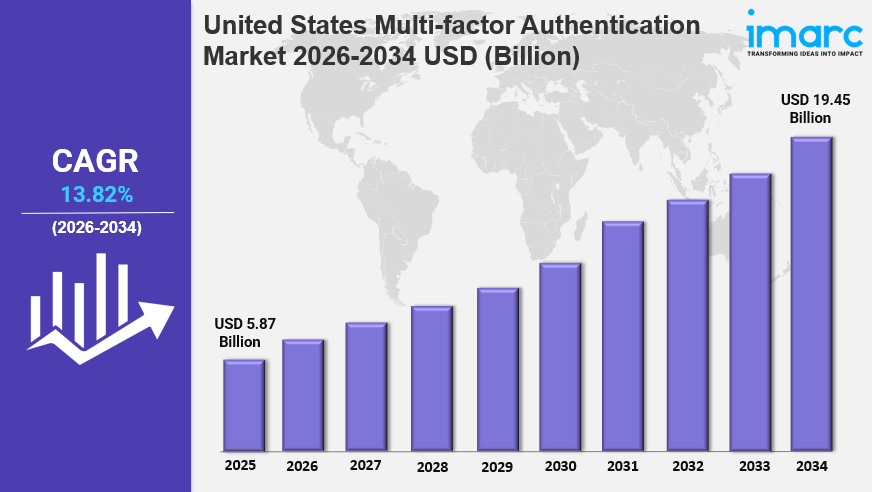
IMARC Group has recently released a new research study titled “United States Multi-factor Authentication Market Size, Share, Trends and Forecast by Model, Deployment Type, Application, Vertical, and Region, 2026-2034”, offers a detailed analysis of the market drivers, segmentation, growth opportunities, trends and competitive landscape to understand the current and future market scenarios.
United States Multi-factor Authentication Market Size, Growth, and Forecast (2026–2034)
The United States multi-factor authentication market size grew from USD 5.87 Billion in 2025 to USD 6.68 Billion in 2026 and is projected to reach USD 19.45 Billion by 2034, growing at a CAGR of 13.82% during 2026-2034. Market expansion is primarily driven by escalating cyber threats, mandatory federal zero-trust and MFA directives under Executive Order 14028, and widespread enterprise cloud migration that requires robust identity verification. On-Cloud deployment commands 69.7% of the market, Phone-Based Authentication leads applications at 54.6%, and the West region holds 33.5% of national revenue.
Additionally, CISA guidance, FFIEC authentication rules for banking, and HIPAA security requirements for healthcare are pushing organizations to treat password-only access as unacceptable. As enterprises move toward passkeys, adaptive authentication, and zero-trust architectures, the United States multi-factor authentication market share of cloud-native and phone-based solutions continues to strengthen, and the United States multi-factor authentication market forecast reflects sustained double-digit expansion through 2034.
Key Market Statistics at a Glance
Base Year: 2025
Historical Years: 2020–2025
Forecast Period: 2026–2034
Market Size (2025): USD 5.87 Billion
Market Size (2026): USD 6.68 Billion
Projected Size (2034): USD 19.45 Billion
Growth Rate: CAGR of 13.82%
Explore Growth Opportunities in the United States Multi-factor Authentication Market Grab IMARC Sample Report for evaluation: https://www.imarcgroup.com/united-states-multi-factor-authentication-market/requestsample
Trends in the United States Multi-factor Authentication Market
The United States multi-factor authentication market trends point toward a rapid shift from SMS-based codes and push notifications to FIDO2 passkeys and other phishing-resistant methods. CISA’s explicit guidance in favor of phishing-resistant MFA is creating replacement cycles across enterprises and government agencies, and United States multi-factor authentication market growth is expected to accelerate as hardware security keys and platform authenticators become standard. In addition, AI-powered adaptive authentication, which evaluates device posture, location, and user behavior to adjust verification requirements in real time, is reducing friction for low-risk access while protecting high-risk activity.
Furthermore, continuous and behavioral authentication is extending MFA beyond the login screen to ongoing session validation, while deeper integration with zero-trust architecture is turning MFA into a core part of unified identity security platforms. Authentication of industrial IoT and operational technology devices is also emerging as a new segment. Overall, these United States multi-factor authentication market trends are reshaping product design and vendor strategies, and rising United States multi-factor authentication market demand for integrated, passwordless solutions is positioning the industry for significant advancement in the coming years.
Market Dynamics of the United States Multi-factor Authentication Market
Mandatory Federal Zero-Trust and MFA Directives
Federal mandates are among the strongest forces shaping the industry. Executive Order 14028 requires federal agencies to adopt MFA as a foundational zero-trust control, creating non-discretionary spending across government bodies and the many contractors that supply federal systems. CISA’s directives are also extending MFA expectations to critical infrastructure sectors, converting adoption from a discretionary security investment into a compliance obligation. This United States multi-factor authentication market analysis shows that mandate-driven buying keeps United States multi-factor authentication market demand resilient even when commercial technology budgets tighten, and new cohorts of regulated organizations continue to enter the buyer base each year.
Escalating Phishing, Ransomware, and Credential Theft
Credential-based attacks account for the majority of enterprise data breaches in the country, and ransomware groups routinely rely on stolen credentials for initial access. As a result, boards are mandating MFA across VPN, email, and privileged access systems, and the high average cost of a data breach gives security leaders a clear return-on-investment argument. This pressure shortens sales cycles, increases average contract values, and sustains United States multi-factor authentication market growth, as organizations deploy MFA comprehensively rather than selectively. The same dynamic lifts United States multi-factor authentication market demand for stronger, phishing-resistant factors.
Cloud Migration, Remote Work, and Regulatory Compliance
Enterprise cloud migration has dissolved the traditional network perimeter, making identity the primary security control. Remote and hybrid work extends authentication to personal devices and home networks, while SaaS-delivered MFA removes capital cost barriers and opens the mid-market. At the same time, FFIEC guidance, HIPAA security rules, PCI DSS 4.0, New York DFS cybersecurity regulations, and California privacy enforcement create overlapping compliance obligations across banking, healthcare, retail, and government. Together, these factors reinforce a strong United States multi-factor authentication market forecast and keep United States multi-factor authentication market growth on a steady upward path through 2034.
United States Multi-factor Authentication Market Key Segmentation:
IMARC Group offers a comprehensive United States multi-factor authentication market analysis of key trends across each market segment, along with regional forecasts for 2026–2034. The report segments the market based on model, deployment type, application, vertical, and region, and highlights that On-Cloud deployment, Phone-Based Authentication, and the West region lead the United States multi-factor authentication market share in their respective categories.
Model Insights:
• Two-Factor Authentication
• Three-Factor Authentication
• Four-Factor Authentication
• Five-Factor Authentication
Deployment Type Insights:
• On-Premises
• On-Cloud
Application Insights:
• Smart Card Authentication
• Phone-Based Authentication
• Hardware OTP Token Authentication
Vertical Insights:
• Banking and Finance
• Government
• Travel and Immigration
• Military and Defence
• IT and Telecom
• Healthcare
• Retail and Ecommerce
• Others
Regional Insights:
• Northeast
• Midwest
• South
• West
United States Multi-factor Authentication Market Competitive Landscape:
The competitive environment is moderately concentrated at the enterprise tier, and this United States multi-factor authentication market analysis shows rivalry intensifying around passwordless differentiation, AI-driven adaptive authentication, and zero-trust identity platform consolidation. Vendors with bundled MFA are gaining United States multi-factor authentication market share through subscription consolidation, while specialists defend position through phishing-resistant and regulated-industry capabilities. These shifts are shaping United States multi-factor authentication market trends, and the United States multi-factor authentication market forecast favors providers with broad integration ecosystems.
Speak to an Analyst: https://www.imarcgroup.com/request?type=report&id=20679&flag=C
United States Multi-factor Authentication Market Key Players
• Microsoft: Provides MFA through Microsoft Entra ID, the Microsoft Authenticator app, and FIDO2 passkeys, with deep integration across Microsoft 365 and Azure
• Okta: Leads cloud-native adaptive MFA with AI-driven risk-based authentication, FastPass passwordless sign-in, and a large library of pre-built integrations
• Cisco Systems, Inc.: Delivers user-friendly MFA through Cisco Duo, combining push authentication, device health checks, and zero-trust network access
• Thales: Offers government-grade MFA through SafeNet Trusted Access, including hardware token, smart card, and cloud authentication for regulated sectors
Author IMARC Group
IMARC Group is a leading global management consulting firm providing in-depth market research, strategic advisory services, and feasibility studies. The firm empowers organizations worldwide with actionable insights and data-driven strategies to support sustainable growth and informed decision-making.
Contact Us
IMARC Group
Email: sales@imarcgroup.com
United States: +1-201-971-6302
- Memes & Cultura da Comunidade
- Artigos e Análises
- Pessoal
- Oportunidade
- Projeto
- Conhecimento
- Dúvidas & Pedidos de Ajuda
- Reflexões & Opiniões
- Tendências
- Oyunlar
- Lançamentos & Anúncios
- Saúde & Bem Estar
- Eventos & Convites
- Conteúdo Técnico
- Entretenimento
- Networking
- Festas & Festivais
- Religião
- Iniciativas de Impacto
 Turkish
 English
 Arabic
 French
 Spanish
 Portuguese
 Deutsch
 Dutch
 Italiano
 Russian
 Romaian
 Portuguese (Brazil)
 Greek