


Skid Steer Loader Market Size to Reach USD 3.1 Billion by 2034, Growing at 1.94% CAGR
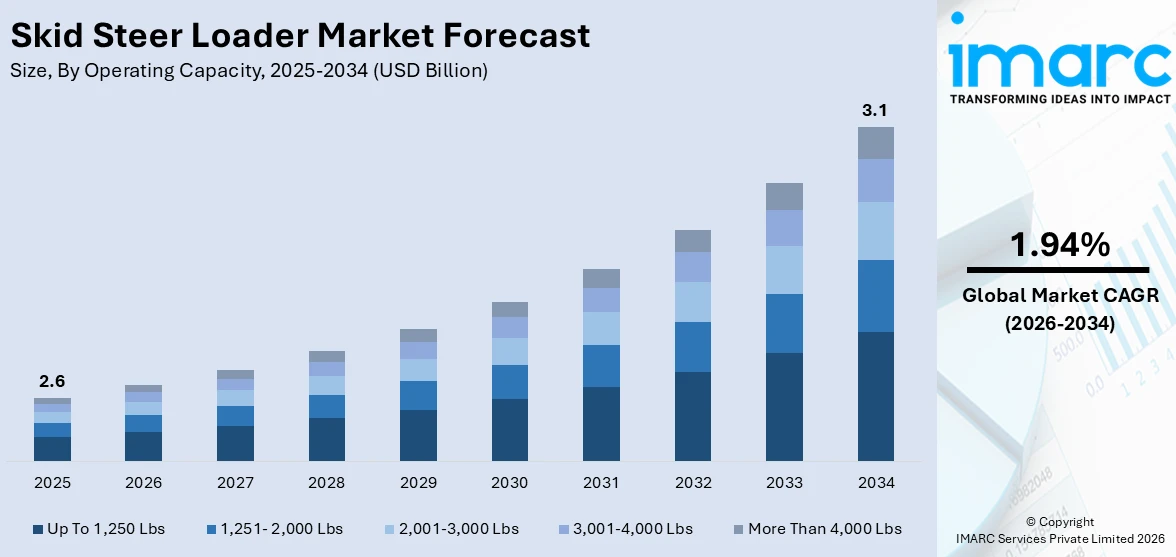
According to a research report by IMARC Group, the global skid steer loader market size reached USD 2.6 Billion in 2025. Looking forward, IMARC Group expects the market to reach USD 3.1 Billion by 2034, exhibiting a growth rate (CAGR) of 1.94% during 2026–2034. Europe currently dominates the regional landscape, holding a market share of 37% in 2025, supported by advanced construction standards, substantial government investments in infrastructure modernization, and widespread adoption of compact machinery across residential and commercial building projects. The market is primarily driven by rising demand for versatile construction equipment, increasing infrastructure development activities, growing agricultural mechanization, and continuous advancements in equipment efficiency and operator comfort.
Skid Steer Loader Market: Key Facts at a Glance
-
Base Year: 2025
-
Historical Period: 2020–2025
-
Forecast Period: 2026–2034
-
Market Size (2025): USD 2.6 Billion
-
Market Forecast (2034): USD 3.1 Billion
-
CAGR (2026–2034): 1.94%
-
Leading Region: Europe (37% share, 2025)
-
Dominant Operating Capacity: Up to 1,250 lbs (30% share)
-
Dominant Power Train: Conventional (85% share)
-
Leading End Use: Construction (45% share)
Skid Steer Loader Market Report: Key Highlights
-
Market Size and Growth: The global skid steer loader market was valued at USD 2.6 Billion in 2025 and is projected to reach USD 3.1 Billion by 2034, registering a CAGR of 1.94% during 2026–2034.
-
Regional Leadership: Europe represents the largest regional market, accounting for 37% of the global market share in 2025, supported by infrastructure modernization, advanced construction standards, and stringent emission regulations.
-
By Operating Capacity: The market is segmented into up to 1,250 lbs, 1,251–2,000 lbs, 2,001–3,000 lbs, 3,001–4,000 lbs, and more than 4,000 lbs, with the up to 1,250 lbs segment holding the largest share at 30%.
-
By Power Train: The market is divided into electric and conventional models, with conventional skid steer loaders accounting for the dominant share of 85%.
-
By End Use: Major end-use segments include construction, mining, logistics, landscaping and ground maintenance, agriculture, and others. Construction represents the leading segment, holding a 45% market share.
-
Key Market Drivers: Increasing infrastructure development, rising demand for compact construction machinery, agricultural mechanization, expanding landscaping activities, and growing adoption of equipment rental models.
-
Key Market Trends: Growing electrification of construction equipment, integration of telematics and smart controls, and expanding applications across agriculture, landscaping, logistics, and municipal services.
-
Key Market Challenges: High equipment acquisition costs, evolving emission requirements, and the need for continuous technological upgrades to meet changing operational and regulatory expectations.
-
Key Market Players: Leading companies include Volvo Group, Yanmar Power Technology Co. Ltd., Doosan Infracore Co. Ltd., Caterpillar Inc., CNH Industrial N.V., Deere & Company, J C Bamford Excavators Ltd, Komatsu Ltd., Kubota Corporation, and Wacker Neuson SE.
Request for a Sample Report for Detailed Evaluation: https://www.imarcgroup.com/skid-steer-loader-market/requestsample
What Is Driving Skid Steer Loader Market Growth in 2026?
Rising Demand for Compact and Versatile Construction Equipment
The growing requirement for compact and versatile construction equipment is significantly supporting the expansion of the skid steer loader market. Rapid urbanization and increasing investments in infrastructure development, including highways, bridges, airports, and residential complexes, are creating demand for maneuverable machinery capable of operating efficiently in confined spaces. Skid steer loaders are particularly suitable for urban construction environments where larger equipment may face operational limitations. Their compact dimensions, high maneuverability, and compatibility with different attachments make them valuable for excavation, material handling, grading, and site preparation activities. Furthermore, the growing adoption of multifunctional equipment among construction contractors is encouraging the use of skid steer loaders as cost-effective alternatives to multiple specialized machines. The increasing preference for rental and leasing arrangements among small- and medium-sized contractors is also improving equipment accessibility by reducing upfront capital expenditure, thereby supporting market growth.
Growing Electrification of Equipment
The increasing shift toward electric and hybrid construction machinery is emerging as a significant trend in the skid steer loader market. Manufacturers are introducing battery-powered models that offer zero tailpipe emissions, reduced noise levels, and lower maintenance requirements compared to conventional diesel-powered equipment. These machines are particularly suitable for indoor applications, urban construction sites, and environmentally sensitive locations where stringent air quality and noise regulations are applicable. Advancements in lithium-ion battery technology are improving operating runtimes and charging efficiency, making electric skid steer loaders increasingly practical for commercial applications. For instance, in February 2025, Tobroco-Giant entered the electric equipment segment with the introduction of two fully electric skid steer loaders, the GS900E wheeled model and the GS950TE tracked model. Developed on the same platform as their combustion-engine counterparts, these machines aim to combine operational performance with environmental benefits. Such developments are encouraging the adoption of cleaner construction equipment and strengthening the long-term market outlook.
Integration of Telematics and Smart Controls
The integration of telematics, automation, and intelligent control systems is transforming equipment productivity and fleet management across the skid steer loader industry. Modern machines are increasingly incorporating GPS tracking, remote diagnostics, real-time performance monitoring, and predictive maintenance capabilities, enabling contractors to optimize equipment utilization and reduce operational downtime. Advanced features such as self-leveling loader arms, automated bucket functions, and customizable joystick controls are also improving operating precision and reducing operator fatigue. These technologies are particularly beneficial for construction companies managing multiple machines across different project locations. For instance, in September 2025, Caterpillar Inc. introduced eight next-generation skid steer loader and compact track loader models, including the Cat 250, 260, 270, and 270 XE. The new lineup features upgraded engine power, enhanced stability, and closed-center auxiliary hydraulics operating at 3,500 psi. These developments highlight the industry's growing focus on equipment performance, intelligent controls, and operational efficiency, supporting the positive skid steer loader market outlook.
Expanding Applications Across Diverse Sectors
The increasing utilization of skid steer loaders beyond conventional construction activities is creating additional growth opportunities across agriculture, landscaping, warehousing, and municipal services. Their compatibility with numerous attachments, including pallet forks, snowblowers, cold planers, trenchers, and tree cutters, enables a single machine to perform multiple tasks efficiently. This versatility is particularly attractive to small and medium-sized contractors and agricultural operators seeking to maximize equipment utilization while minimizing investment in specialized machinery. In agriculture, skid steer loaders are increasingly used for feed handling, barn cleaning, land preparation, and material transportation. Similarly, landscaping companies and municipal authorities utilize these machines for ground maintenance, snow removal, and property management. Furthermore, large-scale infrastructure development programs are increasing demand for compact equipment across emerging economies. India's National Infrastructure Pipeline, which targets USD 1.4 Trillion in capital expenditure, reflects the substantial infrastructure investment environment supporting construction equipment demand. These expanding applications are strengthening the market's growth prospects.
Skid Steer Loader Market Segmentation Analysis
IMARC Group provides an analysis of the key trends in each segment of the global skid steer loader market, along with forecasts at the global, regional, and country levels from 2026–2034. The market has been categorized based on operating capacity, power train, and end use.
By Operating Capacity
-
Up to 1,250 lbs
-
1,251–2,000 lbs
-
2,001–3,000 lbs
-
3,001–4,000 lbs
-
More Than 4,000 lbs
Skid steer loaders with an operating capacity of up to 1,250 lbs account for around 30% of the market share, reflecting their widespread utilization across residential construction, small-scale landscaping, and light agricultural activities. These machines are designed for applications requiring compact dimensions, maneuverability, and efficient performance in confined working environments. Their lightweight construction enables operators to navigate narrow pathways, restricted job sites, and indoor locations where larger machinery may be unsuitable. Moreover, these loaders generally involve lower transportation, acquisition, and rental costs compared to higher-capacity alternatives, making them accessible to independent operators and small- and medium-sized contractors. Their compatibility with different attachments also allows users to perform several light-duty tasks using a single machine. Furthermore, growing investments in urban development and sustainable construction projects across Europe are supporting demand for compact equipment. These advantages continue to reinforce the leading position of the up to 1,250 lbs operating capacity segment.
By Power Train
-
Electric
-
Conventional
Conventional skid steer loaders account for around 85% of the market share, supported by their established presence, operational reliability, and ability to deliver high power output across demanding applications. Diesel-powered models are widely utilized for excavation, material handling, grading, and other construction activities that require consistent torque and performance under heavy loads. Their extensive refueling infrastructure across urban and remote locations further supports their adoption among contractors and fleet operators. In addition, conventional models benefit from established maintenance networks, familiar operating systems, and relatively lower initial acquisition costs compared to newer electric alternatives. Continuous improvements in diesel engine technology, including enhanced fuel efficiency and advanced emission control systems, are also helping manufacturers meet increasingly stringent environmental requirements. Across Europe, evolving machinery regulations and sustainability standards are encouraging equipment manufacturers to incorporate cleaner engines, improved emission controls, and enhanced operational safety features. Although electric models are gaining attention, the established advantages of conventional equipment continue to support its dominant market position.
By End Use
-
Construction
-
Mining
-
Logistics
-
Landscaping and Ground Maintenance
-
Agriculture
-
Others
Construction holds the leading position in the global skid steer loader market, accounting for around 45% of the total market share. The segment's dominance is supported by the extensive utilization of these machines across site preparation, excavation, grading, demolition, and material handling activities. Their compact design and maneuverability make them particularly suitable for congested urban construction sites and restricted working environments where larger machinery may encounter operational limitations. Furthermore, the continuous development of residential, commercial, and public infrastructure projects across developed and emerging economies is strengthening equipment demand. The ability to interchange attachments such as buckets, breakers, and other specialized tools also enhances productivity while reducing the need for multiple machines at individual project sites. For instance, Germany's Federal Transport Infrastructure Plan includes substantial investments in upgrading road, rail, and waterway infrastructure through 2030, supporting sustained demand for construction machinery.
Mining represents another important application area, where skid steer loaders are utilized for material handling, site maintenance, and operations in confined working environments. Their compact dimensions and attachment compatibility make them suitable for specific underground and surface mining activities requiring maneuverable equipment.
Logistics applications are supported by the use of skid steer loaders for material movement, loading, and handling operations across warehouses, industrial facilities, and distribution environments. Their compatibility with pallet forks and other material-handling attachments enhances operational flexibility.
Landscaping and ground maintenance activities are generating demand for skid steer loaders across residential, commercial, and municipal environments. These machines are widely used for grading, snow removal, vegetation management, and property maintenance. Their versatility enables operators to complete different landscaping tasks using interchangeable attachments.
Agriculture is also contributing to market expansion through increasing mechanization across farming operations. Skid steer loaders are utilized for feed handling, barn cleaning, manure management, and general material transportation. Their ability to operate in confined agricultural spaces makes them suitable for farms and livestock facilities.
Request for a Sample Report for Detailed Evaluation: https://www.imarcgroup.com/skid-steer-loader-market/requestsample
Skid Steer Loader Market Regional Analysis
-
North America (United States, Canada)
-
Asia-Pacific (China, Japan, India, South Korea, Australia, Indonesia, Others)
-
Europe (Germany, France, United Kingdom, Italy, Spain, Russia, Others)
-
Latin America (Brazil, Mexico, Others)
-
Middle East and Africa
Europe holds the leading position in the global skid steer loader market, accounting for a share of 37% in 2025. The region's dominance is supported by advanced construction standards, substantial government investments in infrastructure modernization, stringent environmental regulations, and a well-established construction equipment rental ecosystem. European Union initiatives, including the Trans-European Transport Network and Recovery and Resilience Facility, are supporting investments in transportation infrastructure, housing developments, and sustainable construction projects across major economies. Furthermore, the region's growing emphasis on low-emission construction practices and environmentally responsible machinery is encouraging the adoption of fuel-efficient and electric equipment. Countries such as Germany, France, and the United Kingdom represent important demand centers, supported by established construction industries and strong equipment utilization. For instance, Europe's equipment rental sector generated approximately EUR 33.9 Billion in revenue during 2025, with Germany, France, and the United Kingdom collectively accounting for nearly 60% of the market. The region's strong rental ecosystem and infrastructure development activities continue to reinforce its leadership.
Key Regional Takeaways: Europe's Strategic Position
Europe's leadership in the skid steer loader market is anchored in its mature construction industry, advanced infrastructure standards, and increasing investments in sustainable development. Government-backed infrastructure modernization programs and urban redevelopment initiatives are creating consistent demand for compact and maneuverable construction machinery. Additionally, stringent emission regulations and growing environmental awareness are encouraging manufacturers and equipment operators to prioritize fuel-efficient and electric models. The presence of established construction equipment manufacturers, a strong rental ecosystem, and increasing adoption of advanced machinery across residential and commercial building projects is further strengthening the region's market position.
North America Skid Steer Loader Market Analysis
The North American skid steer loader market is supported by extensive infrastructure development programs, a well-established construction equipment rental industry, and strong demand from construction, agriculture, and landscaping applications. Contractors across the region regularly utilize compact machinery to improve productivity across diverse projects, including highway rehabilitation, residential site preparation, and municipal infrastructure maintenance. Federal investment initiatives, particularly the Infrastructure Investment and Jobs Act, which allocated USD 550 Billion for transportation infrastructure, broadband expansion, and energy systems, continue to support a substantial pipeline of construction projects. In addition, the growing preference for equipment rental among small- and medium-sized contractors is improving access to modern machinery while supporting fleet replacement activities. Technological advancements in telematics, hydraulic systems, and operator controls are further enhancing machine efficiency. The increasing utilization of skid steer loaders for snow removal, waste management, and municipal maintenance is also supporting year-round demand across the region.
United States Skid Steer Loader Market Analysis
The United States represents a major contributor to the North American skid steer loader market, driven by its extensive construction industry, agricultural mechanization, and substantial infrastructure investment programs. The country's diverse end-use landscape, covering residential and commercial construction, road development, landscaping, agriculture, and municipal services, is generating consistent demand for compact equipment. Federal and state-level infrastructure initiatives are creating opportunities for manufacturers and equipment rental companies. Moreover, the expansion of data center construction and renewable energy installations is creating additional demand for versatile machinery across specialized job sites. Growing interest in electric and hybrid models is also influencing equipment procurement decisions, particularly among contractors operating in environmentally sensitive urban locations. For instance, in April 2024, FIRSTGREEN Industries introduced ROCKEAT, a new line of electric, cabinless skid steer loaders featuring a low-clearance design, a 360-degree camera system, and remote operation capabilities. These developments reflect the increasing focus on safety, sustainability, and operational flexibility across the United States construction equipment market.
Europe Skid Steer Loader Market Analysis
Europe maintains its leading position in the global skid steer loader market, supported by advanced construction standards, government investments in infrastructure modernization, and a mature equipment rental ecosystem. The European Union's commitment to sustainable development through initiatives such as the European Green Deal and Trans-European Transport Network is encouraging investments in transportation, housing, and green building projects. In addition, stringent emission requirements, including Stage V compliance standards and emerging municipal low-emission policies, are encouraging the adoption of cleaner and more efficient construction machinery. Countries such as Germany, France, and the United Kingdom represent major demand centers, supported by active construction sectors and established rental networks. Urban redevelopment and housing construction programs are also creating demand for compact machinery capable of operating efficiently in space-constrained environments. The region's emphasis on sustainable construction practices and advanced equipment technologies is further strengthening the market outlook.
Asia-Pacific Skid Steer Loader Market Analysis
The Asia-Pacific skid steer loader market is expanding on account of rapid urbanization, increasing infrastructure investments, and growing mechanization across agricultural activities. Countries such as China and India are investing heavily in transportation networks, smart city development, and industrial corridors, generating opportunities for compact construction machinery. Government-backed initiatives, including China's Belt and Road Initiative and India's Bharatmala highway program, are supporting infrastructure development and equipment demand. Furthermore, the expansion of the regional equipment rental market is improving access to construction machinery among smaller contractors. For instance, in June 2024, CASE Construction Equipment introduced its domestically manufactured skid steer loader to the Indian market, produced at its manufacturing facility in Pithampur, Madhya Pradesh. The launch followed the company's earlier announcement of the locally developed model during CII EXCON, highlighting its focus on expanding its compact equipment portfolio in India. These developments reflect the growing importance of Asia-Pacific as a market for construction equipment manufacturers.
Latin America Skid Steer Loader Market Analysis
The Latin American skid steer loader market is witnessing gradual expansion, driven by infrastructure development programs, urbanization, and increasing construction activities across major economies such as Brazil and Mexico. Government investments in transportation, energy, and residential infrastructure are supporting the adoption of compact construction equipment. In addition, increasing agricultural mechanization and mining activities are creating opportunities for skid steer loader manufacturers. The growing need for versatile machinery among contractors and agricultural operators is encouraging demand for equipment capable of performing multiple tasks through interchangeable attachments. Infrastructure modernization and port development projects are also supporting equipment utilization across the region. These developments, combined with the gradual expansion of equipment rental services, are creating further opportunities for market participants.
Middle East and Africa Skid Steer Loader Market Analysis
The Middle East and Africa skid steer loader market is gaining momentum, supported by large-scale infrastructure projects, urban development initiatives, and growing construction activities. Economic diversification programs across Gulf Cooperation Council countries are encouraging investments in residential, commercial, and transportation infrastructure. Saudi Arabia's Vision 2030 and the UAE's urban development plans are generating substantial construction opportunities that require versatile compact machinery. Furthermore, growing investments in commercial facilities, logistics infrastructure, and industrial developments are increasing the utilization of construction equipment. According to the information provided, the GCC construction equipment market reached USD 4.8 Billion in 2024 and is expected to reach USD 10.0 Billion by 2033, exhibiting a CAGR of 7.7% during 2025–2033. This expansion reflects the growing construction activity and equipment requirements across the region, creating additional opportunities for skid steer loader manufacturers.
Competitive Landscape in the Skid Steer Loader Industry
The competitive landscape of the global skid steer loader market is characterized by established construction equipment manufacturers focusing on product innovation, technological advancements, strategic collaborations, and geographical expansion to strengthen their market positions. Leading companies are investing in the development of next-generation machinery featuring enhanced engine performance, advanced hydraulic systems, improved operator comfort, and integrated telematics capabilities. The growing emphasis on environmental sustainability is also encouraging manufacturers to introduce electric and hybrid models that comply with evolving emission requirements. Furthermore, companies are expanding their product portfolios through new model launches and improvements in attachment compatibility to address the diverse requirements of construction, agriculture, mining, and landscaping customers. Equipment rental companies are also influencing purchasing patterns by improving access to modern machinery among smaller contractors. Additionally, investments in aftermarket services, digital fleet management, and customized equipment solutions are helping manufacturers improve customer relationships and strengthen their competitive positioning.
Key Skid Steer Loader Market Players Include:
-
The Volvo Group
-
Yanmar Power Technology Co. Ltd.
-
Doosan Infracore Co. Ltd.
-
Caterpillar Inc.
-
CNH Industrial N.V.
-
Deere & Company
-
J C Bamford Excavators Ltd
-
Komatsu Ltd.
-
Kubota Corporation
-
Wacker Neuson SE
Latest News and Developments in the Skid Steer Loader Industry
-
February 2025: Tobroco-Giant entered the electric equipment segment with the launch of two fully electric skid steer loaders, the GS900E wheeled model and GS950TE tracked model. The machines were developed on the same platform as their combustion-engine counterparts, combining operational capabilities with reduced emissions and noise levels.
-
April 2024: FIRSTGREEN Industries introduced ROCKEAT, a new range of electric, cabinless skid steer loaders. The models feature a low-clearance design, 360-degree camera system, and remote operation capabilities, targeting applications across mining, construction, and other demanding environments.
-
June 2024: CASE Construction Equipment introduced its domestically manufactured skid steer loader to the Indian market. Produced at its Pithampur facility in Madhya Pradesh, the launch strengthened the company's compact equipment portfolio in India.
-
September 2025: Caterpillar Inc. launched eight next-generation skid steer loader and compact track loader models, including the Cat 250, 260, 270, and 270 XE. The new machines feature upgraded engine power, enhanced stability, and closed-center auxiliary hydraulics operating at 3,500 psi.
-
February 2025: Komatsu unveiled a newly developed 4-tonne skid steer loader and a 5-tonne compact track loader at Bauma 2025, expanding its compact equipment portfolio to address evolving construction and infrastructure requirements.
Skid Steer Loader Market Drivers, Challenges & Opportunities
Major Market Drivers
-
Infrastructure Development: Increasing government investments in highways, bridges, airports, residential complexes, and transportation networks are generating sustained demand for compact construction equipment.
-
Growing Agricultural Mechanization: The increasing adoption of mechanized farming practices is supporting skid steer loader utilization for feed handling, land preparation, barn cleaning, and material transportation.
-
Expanding Equipment Rental Market: Growing preference for rental and leasing arrangements among small- and medium-sized contractors is improving equipment accessibility while reducing upfront capital expenditure.
Key Market Challenges
-
High Initial Investment: The acquisition cost of advanced skid steer loaders, particularly electric and technology-integrated models, can limit adoption among smaller contractors and independent operators.
-
Stringent Emission Regulations: Increasingly strict environmental standards require manufacturers to invest in cleaner engines, emission control technologies, and alternative powertrains, potentially increasing production and compliance costs.
Emerging Opportunities
-
Electric and Hybrid Equipment: Growing demand for low-emission construction machinery is creating opportunities for manufacturers to develop battery-powered and hybrid skid steer loaders for urban and indoor applications.
-
Telematics and Smart Equipment: Increasing integration of GPS tracking, remote diagnostics, predictive maintenance, and intelligent controls is creating opportunities to improve fleet management and equipment productivity.
-
Expanding Non-Construction Applications: Rising adoption across agriculture, landscaping, mining, logistics, and municipal services is broadening the customer base and creating additional demand for multifunctional equipment.
Skid Steer Loader Market FAQs
1. How big is the skid steer loader market?
The global skid steer loader market was valued at USD 2.6 Billion in 2025.
2. What is the future outlook of the skid steer loader market?
The global skid steer loader market is projected to reach USD 3.1 Billion by 2034, exhibiting a CAGR of 1.94% during 2026–2034.
3. What are the key factors driving the skid steer loader market?
Key factors include increasing infrastructure development, growing demand for compact construction machinery, agricultural mechanization, expanding landscaping activities, and rising preference for equipment rental and leasing models.
4. Which region accounts for the largest skid steer loader market share?
Europe dominates the global skid steer loader market, accounting for 37% of the market share in 2025, supported by advanced construction standards, infrastructure modernization investments, and stringent environmental regulations.
5. Which are the leading companies in the global skid steer loader market?
Major companies operating in the global skid steer loader market include The Volvo Group, Yanmar Power Technology Co. Ltd., Doosan Infracore Co. Ltd., Caterpillar Inc., CNH Industrial N.V., Deere & Company, J C Bamford Excavators Ltd, Komatsu Ltd., Kubota Corporation, and Wacker Neuson SE.
Conclusion: Skid Steer Loader Market Outlook to 2034
The global skid steer loader market is positioned for steady growth through 2034, supported by increasing infrastructure investments, rising demand for compact construction machinery, and expanding applications across agriculture, landscaping, mining, and municipal services. The versatility of these machines, combined with their maneuverability and compatibility with different attachments, is making them increasingly valuable across diverse operational environments. Furthermore, technological advancements in hydraulic systems, telematics, operator controls, and electric powertrains are enhancing equipment efficiency and supporting the industry's transition toward more sustainable construction practices.
With Europe maintaining its position as the leading regional market and North America, Asia-Pacific, Latin America, and the Middle East and Africa offering further growth opportunities, the market outlook remains positive. Manufacturers focusing on electric equipment development, smart fleet management technologies, improved operational efficiency, and diversified attachment solutions will be better positioned to capitalize on evolving customer requirements and the increasing demand for versatile construction machinery.
About the Author:
IMARC Group is a leading global market research company providing data-driven insights and expert consulting services to businesses seeking to achieve their strategic objectives. With a multidisciplinary team of industry experts, IMARC delivers comprehensive and reliable market intelligence across sectors including Food and Beverages, Healthcare, Chemicals and Materials, Consumer Goods, and more.
Media & Sales Contact:
IMARC Group
United States: +1-201-971-6302
India: +91-120-433-0800
United Kingdom: +44-753-714-6104
- Memes & Cultura da Comunidade
- Artigos e Análises
- Pessoal
- Oportunidade
- Projeto
- Conhecimento
- Dúvidas & Pedidos de Ajuda
- Reflexões & Opiniões
- Tendências
- Oyunlar
- Lançamentos & Anúncios
- Saúde & Bem Estar
- Eventos & Convites
- Conteúdo Técnico
- Entretenimento
- Networking
- Festas & Festivais
- Religião
- Iniciativas de Impacto
 Turkish
 English
 Arabic
 French
 Spanish
 Portuguese
 Deutsch
 Dutch
 Italiano
 Russian
 Romaian
 Portuguese (Brazil)
 Greek