


Smart Spaces Market 2026 | Industry Size, Share, Growth, Trends & Future Outlook Report by 2034
Intelligent Environments Are Reshaping the Future of Buildings and Infrastructure
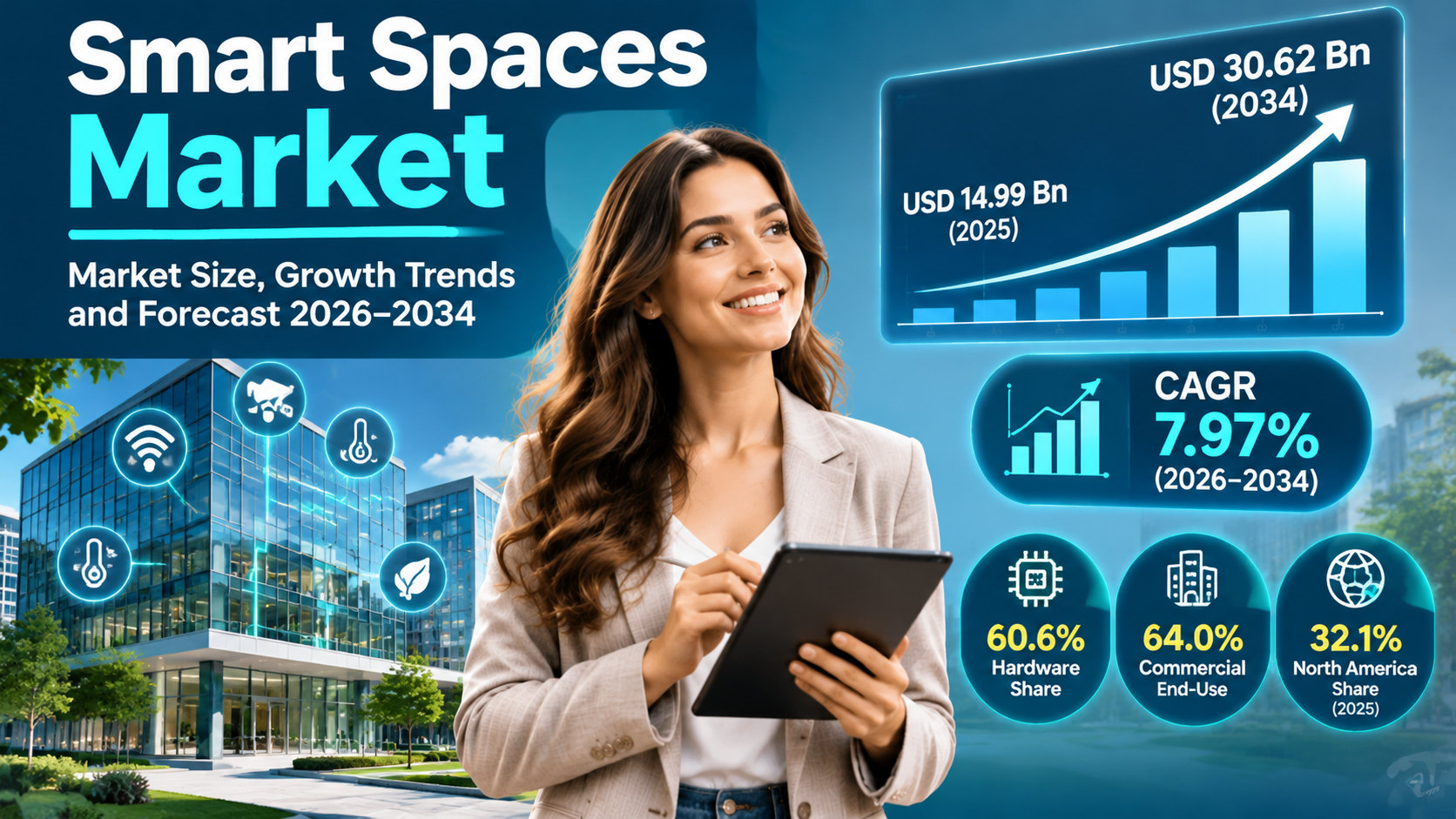
The global smart spaces market growth is witnessing sustained expansion as businesses, governments, and property developers increasingly integrate connected technologies into physical environments. According to IMARC Group, the market reached USD 14.99 Billion in 2025 and is projected to grow from USD 16.58 Billion in 2026 to USD 30.62 Billion by 2034, exhibiting a CAGR of 7.97% during 2026–2034. This growth reflects the increasing adoption of Internet of Things (IoT) devices, artificial intelligence (AI), cloud-based building management platforms, and automated infrastructure designed to improve operational efficiency, energy consumption, and occupant experiences.
Smart spaces are emerging as an important component of digital transformation across commercial buildings, residential complexes, healthcare facilities, industrial environments, and public infrastructure. Organizations are moving beyond conventional building management systems toward interconnected environments that use real-time data and intelligent automation to optimize lighting, heating, ventilation, air conditioning (HVAC), security, and space utilization. Government-backed smart city programs, growing investments in sustainable infrastructure, and the structural shift toward hybrid working arrangements are further accelerating adoption.
Hardware remains the largest component segment, accounting for 60.6% of the global market in 2025, supported by demand for connected sensors, smart cameras, controllers, and IoT gateways. Commercial applications dominate the end-user landscape with a 64.0% share, reflecting the growing deployment of intelligent building solutions across corporate offices, retail establishments, hospitals, and educational institutions. Regionally, North America leads with a 32.1% market share, while Asia-Pacific represents the fastest-growing regional market, supported by extensive smart city investments and rapid urbanization.
Smart Spaces Market: Key Figures and Growth Indicators
The following indicators highlight the market's current position and projected development:
-
Market Size (2025): USD 14.99 Billion
-
Market Size (2026): USD 16.58 Billion
-
Projected Market Size (2034): USD 30.62 Billion
-
Growth Rate (2026–2034): 7.97% CAGR
-
Historical Period: 2020–2025
-
Forecast Period: 2026–2034
-
Largest Regional Market: North America (32.1% share, 2025)
-
Fastest-Growing Region: Asia-Pacific (~9.8% CAGR)
-
Leading Component: Hardware (60.6% share, 2025)
-
Leading End-User: Commercial (64.0% share, 2025)
-
Leading Space Type: Smart Indoor Space (62.5% share, 2025)
-
Leading Application: Emergency and Disaster Management (39.5% share, 2025)
Understanding the Smart Spaces Market: From Connected Buildings to Intelligent Ecosystems
Smart spaces represent technologically integrated physical environments where people, connected devices, software platforms, and data analytics interact to improve building performance and user experiences. These environments combine IoT sensors, AI-powered analytics, cloud connectivity, automation technologies, and building management systems (BMS) to facilitate real-time monitoring and intelligent decision-making.
Unlike conventional buildings that depend heavily on manual controls and isolated operational systems, smart spaces use interconnected technologies to coordinate multiple building functions. For example, occupancy sensors can automatically adjust lighting and HVAC settings according to the number of people in a particular area, while predictive analytics can identify equipment performance issues before they develop into costly failures.
The application of smart space technologies extends across energy management, space utilization, emergency response, security monitoring, and integrated facility management. Smart indoor environments include offices, hospitals, residential buildings, educational institutions, and retail complexes, whereas smart outdoor environments encompass campuses, parking infrastructure, public spaces, and smart city districts.
The growing importance of these environments is closely associated with the building sector's environmental footprint. Buildings account for approximately 40% of global CO2 emissions, creating considerable demand for technologies that support energy optimization, sustainable building operations, and net-zero infrastructure objectives.
Four Major Forces Accelerating Smart Spaces Market Expansion
1. Government-Led Smart City Investments Are Expanding Deployment Opportunities
Government investment in smart city infrastructure is creating significant opportunities for smart spaces technology providers. Public authorities worldwide are increasingly prioritizing connected infrastructure, intelligent transportation systems, automated public services, energy-efficient buildings, and integrated security networks to improve urban management.
India's Smart Cities Mission represents an important example of this investment momentum. Launched in 2015 with the objective of developing 100 smart cities, the initiative had completed 7,188 projects, representing approximately 90% of total projects, with investments amounting to ₹1,44,237 crore as of July 3, 2024. These initiatives demonstrate how government-backed infrastructure development can accelerate the deployment of connected building systems, intelligent monitoring technologies, and integrated urban management platforms.
Similarly, China's smart urbanization initiatives and Saudi Arabia's Vision 2030 infrastructure development are creating opportunities for technology providers offering scalable building automation, IoT connectivity, and intelligent infrastructure solutions. As governments continue to prioritize digital transformation and sustainable urban development, smart spaces are becoming an increasingly important part of public infrastructure planning.
2. AI and IoT Automation Are Improving Building Efficiency and Reducing Operating Costs
The integration of artificial intelligence and IoT technologies is transforming conventional facility management into a data-driven operational model. Connected sensors continuously collect information about temperature, occupancy, lighting, equipment performance, and energy consumption, enabling building management platforms to make automated adjustments in real time.
AI-powered energy optimization systems can reduce energy costs by approximately 20–40% by improving HVAC scheduling, adjusting lighting according to occupancy, and identifying inefficient equipment operations. These capabilities allow building operators to move away from reactive maintenance and manual energy management toward predictive and automated operating models.
For commercial property owners, the financial benefits extend beyond utility savings. Predictive maintenance can reduce unexpected equipment failures, improve asset utilization, and extend the operational life of building infrastructure. Growing pressure to improve operational profitability is therefore encouraging enterprises to invest in integrated smart building solutions.
3. Hybrid Work Models Are Reshaping Commercial Real Estate Requirements
The widespread adoption of hybrid and remote working arrangements has changed how organizations utilize office infrastructure. Businesses increasingly require flexible workspaces that can accommodate changing employee attendance patterns while maintaining productivity and controlling real estate costs.
Approximately 74% of US companies plan to maintain permanent hybrid work policies, creating demand for intelligent occupancy monitoring, workplace analytics, automated meeting room management, and flexible space allocation technologies.
Smart workplace platforms enable organizations to understand how employees use office facilities and identify underutilized areas. Integrated occupancy sensors and workplace management applications can support desk reservations, meeting room scheduling, visitor management, and environmental adjustments based on actual usage patterns.
These capabilities are encouraging commercial property owners and enterprises to invest in smart spaces that deliver greater operational flexibility and improved employee experiences.
4. Net-Zero Building Regulations Are Strengthening Demand for Intelligent Infrastructure
Environmental sustainability has become an important consideration in commercial property development and infrastructure management. Buildings contribute approximately 40% of global CO2 emissions, making energy-efficient operations essential to achieving national and international climate objectives.
Regulatory developments are reinforcing this transition. Under the revised European Energy Performance of Buildings Directive, EU member states are required to achieve zero-emission standards for new public buildings from 2028 and all new buildings from 2030, alongside a broader transition toward zero-emission building stock by 2050.
Smart spaces technologies support these objectives through automated energy monitoring, intelligent HVAC controls, predictive maintenance, and real-time resource optimization. In addition, sustainability certifications such as LEED, BREEAM, and WELL are encouraging property developers and institutional investors to prioritize intelligent building infrastructure.
As environmental performance becomes increasingly important in commercial real estate investment decisions, demand for integrated energy management and building automation solutions is expected to strengthen.
Request a Sample Report: https://www.imarcgroup.com/smart-spaces-market/requestsample
Technology Trends Transforming the Smart Spaces Industry
The smart spaces industry is evolving beyond basic connectivity and automation toward intelligent ecosystems capable of predictive decision-making, autonomous operations, and continuous performance optimization.
Digital Twins Are Enabling Predictive Building Management
Digital twin technology is emerging as an important tool for managing complex building environments. By creating virtual representations of physical infrastructure, digital twin platforms allow facility managers to simulate building performance, evaluate renovation scenarios, analyze energy consumption, and test emergency response procedures without making physical changes.
Solutions such as Microsoft Azure Digital Twins enable organizations to integrate data from connected assets and building systems into unified digital environments. This supports more informed maintenance planning, operational optimization, and lifecycle management.
Cloud-Native Platforms Are Replacing Conventional Building Management Systems
The transition toward cloud-based software-as-a-service (SaaS) platforms is reshaping the deployment of smart building technologies. Traditional on-premise building management systems often require substantial infrastructure investment and ongoing maintenance. Cloud-native platforms offer greater scalability, remote accessibility, centralized monitoring, and integration with third-party applications.
Companies are increasingly adopting subscription-based smart building platforms to reduce upfront infrastructure requirements and gain access to continuous software improvements. This transition is also creating recurring revenue opportunities for technology providers.
5G and Edge Computing Are Improving Real-Time Responsiveness
The combination of 5G connectivity and edge computing is supporting more responsive smart space applications. By processing information closer to connected devices, edge computing can reduce dependence on centralized cloud infrastructure and improve response times for time-sensitive applications.
These capabilities are particularly relevant for large commercial facilities, smart warehouses, airports, and industrial environments that require coordinated monitoring of multiple connected systems. Applications include autonomous robot navigation, emergency response coordination, and real-time anomaly detection.
Sustainable Building Certifications Are Encouraging Technology Investment
Environmental building certifications are increasingly influencing investment decisions among corporate tenants, property developers, and institutional investors. Standards such as LEED, BREEAM, and WELL encourage improved energy performance, indoor environmental quality, and sustainable building management.
Smart lighting, automated HVAC systems, occupancy monitoring, and intelligent energy management platforms are helping property owners improve building performance and support sustainability certification objectives.
Where Is the Smart Spaces Market Growing Fastest? A Regional Perspective
North America currently represents the largest regional market, while Asia-Pacific is emerging as the fastest-growing market through 2034.
North America: Leading Through Enterprise Digital Transformation
North America accounted for 32.1% of the global smart spaces market in 2025. Its leadership is supported by strong enterprise technology investments, established building automation infrastructure, increasing sustainability requirements, and the presence of major technology providers.
The United States represents the largest contributor within the region, benefiting from widespread adoption of intelligent building management systems and growing investments in connected commercial infrastructure.
Government and private-sector initiatives are further supporting market expansion. Honeywell's Smart City Accelerator program, launched in collaboration with Accelerator for America in 2022, targeted cities including Cleveland, Louisville, Kansas City, San Diego, and Waterloo to support improvements in climate resilience, public safety, and operational efficiency.
The US Department of Energy's Better Buildings Initiative has also demonstrated the economic and environmental benefits of building efficiency investments. Working with nearly 1,000 business and government partners, the initiative achieved USD 13.5 Billion in energy cost savings and reduced carbon emissions by more than 130 million metric tons.
Asia-Pacific: The Fastest-Growing Market Through 2034
Asia-Pacific accounted for 27.6% of the global market in 2025 and is projected to expand at approximately 9.8% CAGR during 2026–2034. Rapid urbanization, rising infrastructure investments, expanding commercial real estate development, and government-led smart city programs are supporting the region's growth.
India's Smart Cities Mission is creating opportunities for connected infrastructure, intelligent public services, and automated building management solutions. China's smart urbanization initiatives are similarly supporting the deployment of connected residential and commercial infrastructure.
Other markets, including Japan, South Korea, Thailand, and Southeast Asian economies, are increasing their focus on digital infrastructure and intelligent urban development.
Europe: Sustainability Regulations Supporting Smart Building Adoption
Europe represented 21.4% of the global smart spaces market in 2025. The region benefits from stringent energy efficiency requirements, established building automation capabilities, and growing investment in sustainable infrastructure.
The revised Energy Performance of Buildings Directive is strengthening the transition toward energy-efficient and zero-emission buildings. Meanwhile, growing adoption of LEED, BREEAM, and other sustainability-oriented building standards is encouraging investments in automated energy management and intelligent facility operations.
Latin America: Digital Infrastructure Creating New Opportunities
Latin America accounted for 9.8% of the global market in 2025. Increasing investment in commercial infrastructure, urban modernization, and digital transformation is creating opportunities for smart building technology providers.
Brazil and Mexico represent important markets for connected building systems, while initiatives across Colombia and other regional economies are supporting broader digital infrastructure development.
Middle East and Africa: Smart City Projects Driving Long-Term Demand
The Middle East and Africa represented 9.1% of the global market in 2025. Large-scale urban development and government-backed modernization programs are supporting the adoption of intelligent infrastructure.
Saudi Arabia's Vision 2030, including the NEOM development project, represents an important opportunity for smart building and connected infrastructure providers. The UAE is also investing in smart government services, intelligent urban management, and digital infrastructure through initiatives in Dubai and Abu Dhabi.
Across Africa, growing infrastructure requirements and digital transformation investments are creating additional opportunities for connected facility management and intelligent building solutions.
Market Segmentation: Which Categories Are Leading Adoption?
The global smart spaces market can be evaluated across component, space type, application, end-user, and regional categories. Each segment reflects different technology requirements and adoption patterns.
By Component: Hardware Leads, While Software Gains Momentum
Hardware represented 60.6% of the global market in 2025, making it the largest component category. This segment includes IoT sensors, smart HVAC controllers, lighting systems, occupancy detectors, cameras, actuators, and connectivity gateways.
The increasing deployment of connected devices is strengthening hardware demand, as these components form the physical infrastructure required to collect information and automate building operations.
Software accounted for 24.3% of the market in 2025 and is projected to grow at approximately 9.4% CAGR during 2026–2034. It represents the fastest-growing component segment, supported by rising adoption of cloud-based building management platforms, AI-powered analytics, predictive maintenance, and integrated facility management applications.
Services represented the remaining 15.1%, encompassing system design, installation, integration, commissioning, training, and ongoing maintenance. Increasing system complexity is supporting demand for specialized implementation and managed services.
By Space Type: Smart Indoor Environments Dominate
Smart indoor spaces accounted for 62.5% of the global market in 2025. These environments include corporate offices, hospitals, retail establishments, educational institutions, residential buildings, and commercial facilities.
Growing demand for energy-efficient building operations, intelligent environmental controls, and automated facility management is supporting this segment's leadership.
Smart outdoor spaces represent another important category, encompassing intelligent campuses, connected parking facilities, public infrastructure, and smart city environments. Growing urbanization and government investments in connected public infrastructure are supporting adoption in this segment.
By Application: Emergency and Disaster Management Holds the Largest Share
Emergency and disaster management accounted for 39.5% of the market in 2025. Smart spaces technologies support this application through connected surveillance systems, automated alerts, environmental sensors, integrated communication networks, and real-time monitoring platforms.
These capabilities help building operators identify potential hazards, coordinate emergency responses, and improve occupant safety.
Other major applications include energy management and optimization, layout and space management, security management, and integrated facility management. Increasing requirements for operational efficiency and building resilience are supporting demand across these applications.
By End-User: Commercial Buildings Remain the Primary Adoption Center
Commercial applications represented 64.0% of the global market in 2025. Corporate offices, shopping centers, hospitals, airports, educational institutions, and large commercial facilities are increasingly deploying smart spaces technologies to improve energy efficiency, optimize occupancy, and enhance building security.
Commercial buildings also face growing pressure to reduce energy consumption and comply with sustainability requirements, making intelligent building management an important operational investment.
Residential applications accounted for the remaining 36.0% of the market. Increasing consumer interest in connected homes, smart thermostats, automated lighting, and home energy management systems is supporting adoption in this segment.
Competitive Landscape: Technology Integration Is Becoming a Key Differentiator
The global smart spaces market is moderately concentrated, with competition shaped by established technology conglomerates, building automation providers, networking companies, and specialized software developers.
Leading companies are increasingly focusing on integrated hardware-software ecosystems that combine building automation, cloud analytics, security, energy management, and connected workplace applications.
Rather than competing exclusively through individual devices, market participants are emphasizing interoperability, cybersecurity, digital twin capabilities, AI-powered analytics, and recurring software services.
Major companies operating in the market include:
-
Siemens AG
-
Honeywell International
-
ABB Ltd.
-
Cisco Systems Inc.
-
IBM Corporation
-
Hitachi Digital Services
-
Smarten Spaces
Siemens AG: Siemens is strengthening its smart infrastructure portfolio through platforms such as Building X and Desigo CC. Its strategy focuses on integrating building automation, energy management, security, and digital twin capabilities into a unified cloud-connected ecosystem. The company's partnership with Smart Spaces in 2021 also supported its expansion into the Middle East and higher education markets.
Honeywell International: Honeywell offers building automation, HVAC controls, security technologies, and connected facility management solutions through its Honeywell Forge and Niagara platforms. Its March 2026 collaboration with Rhombus to enhance cloud-connected security and access systems with AI-driven video technologies reflects its continued focus on intelligent building security.
ABB Ltd.: ABB operates across smart electrification, building automation, energy management, and connected infrastructure. Its ABB Ability BuildingPro platform, launched in November 2025, is designed to connect, manage, and optimize building operations through an integrated and cybersecure architecture.
Cisco Systems Inc.: Cisco focuses on network-enabled smart building and connected workplace solutions. Cisco Spaces and Meraki MV smart cameras support location intelligence, occupancy analytics, and security monitoring, while its networking infrastructure provides connectivity for integrated smart space deployments.
IBM Corporation: IBM participates in the smart spaces ecosystem through its Maximo asset management platform and AI-powered predictive maintenance capabilities. Its solutions support equipment monitoring, asset lifecycle management, and operational optimization across complex facilities.
Hitachi Digital Services: Hitachi leverages its Lumada platform to provide IoT analytics, digital twin capabilities, and data-driven facility management solutions.
Smarten Spaces: Smarten Spaces specializes in workplace experience and occupancy optimization through its Jumpree platform, supporting organizations seeking to manage flexible office environments and hybrid working arrangements.
Request a Sample Report: https://www.imarcgroup.com/smart-spaces-market/requestsample
Investment Opportunities: Where Can the Next Phase of Growth Emerge?
The smart spaces industry offers opportunities across high-growth software platforms, specialized infrastructure applications, and emerging geographic markets.
AI-Native Building Management Platforms
Software represents an attractive investment category, with projected growth of approximately 9.4% CAGR through 2034. AI-powered platforms that integrate energy optimization, predictive maintenance, occupancy analytics, and automated facility management are becoming increasingly important.
Software businesses also benefit from recurring subscription models and opportunities to expand their services across existing enterprise customers.
Healthcare and Data Center Infrastructure
Healthcare facilities and data centers represent high-value application opportunities. Hospitals require intelligent environmental controls, real-time equipment tracking, automated security, and advanced HVAC monitoring to support operational efficiency and patient safety.
Data centers, meanwhile, require continuous environmental monitoring, energy optimization, equipment management, and predictive maintenance. Growing digital infrastructure requirements are creating additional opportunities for specialized smart space solutions.
Digital Twin and Building Lifecycle Management
Digital twin platforms are opening new opportunities in building design, renovation, asset management, and energy optimization. By simulating operational conditions, these technologies allow property owners to evaluate infrastructure improvements before implementing physical changes.
This capability can improve capital expenditure planning, reduce operational risks, and support long-term building performance management.
Emerging Markets and Large-Scale Smart City Developments
Asia-Pacific represents a significant growth opportunity with its projected 9.8% CAGR. India, China, and Southeast Asian economies are investing in smart urban infrastructure, connected public services, and intelligent commercial developments.
Similarly, Saudi Arabia's NEOM project and the UAE's smart city initiatives are creating opportunities for technology providers with expertise in integrated building automation and large-scale infrastructure deployment.
Challenges That Could Influence Market Adoption
Despite strong growth opportunities, the smart spaces industry faces several challenges that could affect implementation and adoption.
High Initial Investment Requirements: Deploying smart building infrastructure requires hardware procurement, network upgrades, software licensing, system integration, and ongoing maintenance. These expenses can create financial barriers for small and medium-sized property owners.
Cybersecurity Risks: Connected building systems increase the number of potential entry points for cyberattacks. HVAC controllers, access management systems, lighting networks, and IoT devices require robust cybersecurity frameworks to protect critical infrastructure.
Shortage of Specialized Technical Professionals: Smart spaces deployment requires expertise across information technology, operational technology, networking, cybersecurity, and building engineering. The limited availability of professionals with cross-disciplinary capabilities can complicate implementation and maintenance.
Data Privacy and Regulatory Compliance: Occupancy sensors, thermal imaging systems, and connected workplace platforms generate information about building utilization and occupant behavior. Compliance with regulations such as GDPR, CCPA, and China's PIPL creates additional requirements for data collection, consent, storage, and processing.
Addressing these challenges through standardized integration frameworks, stronger cybersecurity practices, and skilled workforce development will be important for sustainable market expansion.
Future Outlook: Smart Spaces Will Become Central to Intelligent Infrastructure
The global smart spaces market is positioned for sustained expansion through 2034, supported by the convergence of AI, IoT, cloud computing, digital twins, and connected infrastructure. The market is projected to increase from USD 14.99 Billion in 2025 to USD 16.58 Billion in 2026 and reach USD 30.62 Billion by 2034, registering a CAGR of 7.97% during 2026–2034.
The next phase of development will be shaped by the transition from basic building automation toward predictive and autonomous facility management. AI-enabled systems will increasingly coordinate energy consumption, occupancy patterns, security operations, and equipment performance through integrated platforms.
Software adoption is expected to accelerate as organizations prioritize cloud-native building management and analytics solutions. Meanwhile, hardware will remain fundamental to market development by providing the connected infrastructure required for intelligent operations.
Regionally, North America is expected to maintain a significant position through established enterprise adoption and sustainability investments, while Asia-Pacific is likely to remain the fastest-growing regional market because of rapid urbanization and large-scale smart city development.
Ultimately, companies that combine interoperable technologies, AI-driven analytics, cybersecurity capabilities, and sustainable infrastructure solutions will be well-positioned to benefit from the growing global demand for intelligent environments.
Frequently Asked Questions About the Smart Spaces Market
1. What is the current size of the global smart spaces market?
The global smart spaces market reached USD 14.99 Billion in 2025 and is estimated to reach USD 16.58 Billion in 2026.
2. What is the projected size of the smart spaces market by 2034?
The market is projected to reach USD 30.62 Billion by 2034, exhibiting a CAGR of 7.97% during 2026–2034.
3. What are the major factors driving smart spaces market growth?
Key growth drivers include government smart city investments, increasing adoption of AI and IoT technologies, demand for energy-efficient buildings, hybrid working arrangements, and net-zero building regulations.
4. Which component dominates the smart spaces market?
Hardware dominates the component segment, accounting for 60.6% of the global market in 2025, supported by demand for IoT sensors, smart HVAC controllers, connected cameras, and building automation devices.
5. Which end-user segment holds the largest market share?
The commercial segment leads the market, accounting for 64.0% of the global market in 2025, driven by adoption across corporate offices, hospitals, retail facilities, airports, and educational institutions.
6. Which region dominates the global smart spaces market?
North America is the leading regional market, accounting for 32.1% of the global market in 2025.
7. Which region is expected to grow fastest during the forecast period?
Asia-Pacific is the fastest-growing regional market, with an estimated CAGR of approximately 9.8% during 2026–2034, supported by smart city investments, urbanization, and digital infrastructure development.
8. What are the emerging technology trends in the smart spaces industry?
Major trends include AI-powered building automation, digital twin integration, cloud-native building management platforms, 5G connectivity, edge computing, and intelligent energy management systems.
9. Who are the leading companies in the smart spaces market?
Major market participants include Siemens AG, Honeywell International, ABB Ltd., Cisco Systems Inc., IBM Corporation, Hitachi Digital Services, and Smarten Spaces.
10. What are the key challenges facing the smart spaces industry?
Major challenges include high upfront installation costs, cybersecurity vulnerabilities, shortages of specialized technical professionals, and data privacy concerns associated with connected occupancy monitoring systems.
About IMARC Group
IMARC Group is a leading global market research company providing data-driven insights and expert consulting services to businesses seeking to achieve their strategic objectives. With a multidisciplinary team of industry experts, IMARC delivers comprehensive market intelligence across sectors including Food and Beverages, Healthcare, Chemicals and Materials, Consumer Goods, and more.
- Memes & Cultura da Comunidade
- Artigos e Análises
- Pessoal
- Oportunidade
- Projeto
- Conhecimento
- Dúvidas & Pedidos de Ajuda
- Reflexões & Opiniões
- Tendências
- Games
- Lançamentos & Anúncios
- Saúde & Bem Estar
- Eventos & Convites
- Conteúdo Técnico
- Entretenimento
- Networking
- Festas & Festivais
- Religião
- Iniciativas de Impacto
 English
 Arabic
 French
 Spanish
 Portuguese
 Deutsch
 Turkish
 Dutch
 Italiano
 Russian
 Romaian
 Portuguese (Brazil)
 Greek