


Synthetic Biology Market 2026 | Industry Size, Share, Growth, Trends & Future Outlook Report by 2034
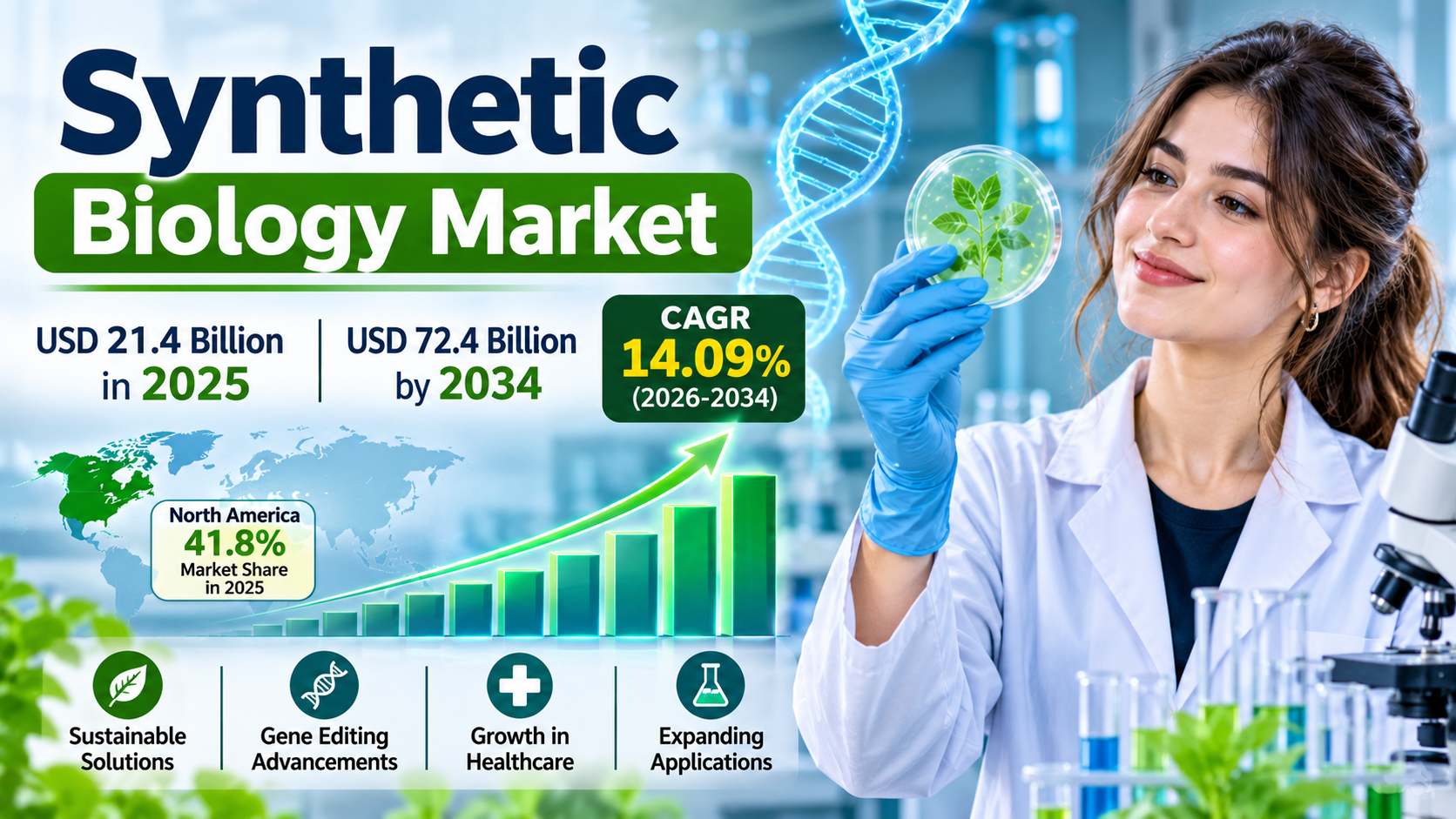
IMARC Group’s latest research indicates that the global synthetic biology market was valued at USD 21.4 billion in 2025 and is projected to reach USD 72.4 billion by 2034, exhibiting a CAGR of 14.09% during 2026-2034. Growing applications in healthcare, agriculture, bio-based chemicals and renewable energy are supporting market expansion. Advances in gene synthesis, genome editing, artificial intelligence (AI) and machine learning (ML) are enabling researchers and businesses to design biological systems with greater precision, creating new opportunities across industries.
Five Forces Moving the Market
-
Advancements in gene editing technologies. Technologies such as CRISPR-Cas9 are improving the precision and efficiency of genetic manipulation. Researchers are using these tools to design biological systems, develop gene therapies, create engineered organisms and produce valuable compounds, including enzymes and biofuels. These developments are expanding synthetic biology applications across healthcare and industrial biotechnology.
-
Growing demand for sustainable solutions. Increasing emphasis on environmental sustainability is encouraging industries to explore bio-based alternatives to conventional materials and production processes. Synthetic biology supports the development of bioplastics, biofuels, renewable chemicals and engineered microorganisms for bioremediation, helping address environmental challenges.
-
Rising healthcare and pharmaceutical applications. Synthetic biology is increasingly being used in drug discovery, personalized medicine, therapeutic development and diagnostics. Engineered cell therapies, synthetic vaccines and gene therapies are creating new possibilities for treating cancer, autoimmune disorders and rare genetic diseases.
-
Artificial intelligence and machine learning integration. AI and ML tools are accelerating biological design through predictive modelling, data analysis and process automation. These technologies help researchers identify suitable biological pathways, improve experimental efficiency and support the development of synthetic proteins and engineered organisms.
-
Collaborative research and investment. Partnerships between universities, research institutions, biotechnology companies and government organizations are supporting innovation and commercialization. Research grants, venture capital funding and supportive government initiatives are helping biotechnology startups and established companies advance synthetic biology technologies.
What could influence market adoption: The development and commercialization of synthetic biology solutions depend on continued research investment, supportive regulatory frameworks, effective biosecurity measures and collaboration between scientific institutions and industry participants.
Segment Breakdown
By product. Oligonucleotide/oligo pools and synthetic DNA are the largest product segment, accounting for approximately 35.5% of the market in 2025. These products are widely used in gene synthesis, PCR, sequencing, gene editing and therapeutic development. Growing adoption of CRISPR-Cas9, personalized medicine and vaccine development is strengthening demand. Other product categories include enzymes, cloning technologies kits, xeno-nucleic acids and chassis organisms.
By technology. PCR technology leads the market with a share of approximately 30.3% in 2025. Its ability to amplify specific DNA sequences makes it important for cloning, gene editing, functional genomics, diagnostics and biomanufacturing. Advancements in digital and real-time PCR are improving sensitivity, efficiency and processing speed. Other technologies covered include next-generation sequencing (NGS), genome editing, bioprocessing and other emerging technologies.
By application. Healthcare dominates the market, accounting for approximately 57.5% of the global share in 2025. Clinical applications include gene therapies, synthetic vaccines and engineered cell therapies, while non-clinical applications cover drug discovery, functional genomics, disease modelling and diagnostics. Non-healthcare applications include biotechnology crops, specialty chemicals, biofuels and other industrial uses.
Regional Outlook
-
North America: The largest regional market, accounting for over 41.8% of global revenue in 2025. Its leadership is supported by advanced biotechnology infrastructure, strong research investments, established academic institutions, venture capital funding and government initiatives. The region also benefits from developments in gene therapies, synthetic vaccines, biofuels and sustainable materials.
-
Asia Pacific: Growth is supported by expanding biotechnology research, government-backed innovation programmes and increasing demand for sustainable bio-based products. Applications in agriculture, healthcare, biofuels and biodegradable materials are creating opportunities across China, Japan, India, South Korea and other regional markets.
-
Europe: The market is benefiting from investments in genetic engineering, CRISPR technology, gene synthesis and sustainable manufacturing. Growing demand for bio-based chemicals, biodegradable materials, advanced therapies and resilient agricultural solutions is supporting industry development.
-
Latin America: Biotechnology research, agricultural innovation and increasing interest in biofuels and sustainable chemicals are creating new opportunities. Brazil and Argentina are developing biotechnology ecosystems through collaborations between research institutions, startups and private companies.
-
Middle East and Africa: The region is included in the report’s geographical assessment, with opportunities associated with biotechnology development and the adoption of synthetic biology applications across healthcare, agriculture and industrial sectors.
Competitive Landscape
Competition in the synthetic biology market centres on technological innovation, research capabilities, product development, strategic partnerships and manufacturing expansion. Companies are investing in advanced gene-editing tools, synthetic DNA technologies and bioengineering platforms to address growing demand across healthcare, agriculture and industrial biotechnology.
Leading companies include Agilent Technologies Inc., Amyris Inc., Codexis Inc., Danaher Corporation, Eurofins Scientific, GenScript Biotech Corporation, Illumina Inc., Merck KGaA, New England Biolabs, Synthego Corporation, Thermo Fisher Scientific Inc., Twist Bioscience and Viridos Inc.
Integrated DNA Technologies (IDT) is among the companies advancing the market through innovations in gene synthesis and manufacturing. In 2024, the company introduced Rapid Genes, a next-generation gene synthesis solution offering NGS-verified clonal genes with delivery in as little as five business days. The development supports faster research operations, drug discovery and genomics applications.
Latest Industry Moves
-
May 2024: Integrated DNA Technologies (IDT) expanded its synthetic biology operations by opening a new 25,000-square-foot facility in Coralville, Iowa. The two-story facility is dedicated to manufacturing synthetic biology products.
-
December 2023: The Allen Institute, Chan Zuckerberg Initiative and University of Washington announced the launch of the Seattle Hub for Synthetic Biology. The collaboration aims to develop technologies that can record the history of cells over time.
-
2024: The US National Science Foundation awarded a USD 15 million grant to establish the iBioFoundry at the University of Illinois Urbana-Champaign. The centre combines synthetic biology, AI and robotics to advance biomanufacturing, protein engineering and sustainable technologies.
Where the Opportunities Are
Healthcare represents one of the most significant opportunities for synthetic biology companies. Growing interest in personalized medicine, engineered cell therapies, synthetic vaccines and advanced diagnostics is creating demand for innovative biological tools and platforms.
The transition toward sustainable manufacturing is another important opportunity. Companies are exploring engineered microorganisms and biological production processes to develop biofuels, bioplastics, specialty chemicals and other renewable materials. These applications can support efforts to reduce dependence on conventional petroleum-based production.
Agriculture also offers opportunities through the development of biotechnology crops with improved yields and pest resistance. In addition, AI-driven biological design, advanced DNA synthesis and genome-editing technologies are opening new possibilities for research and commercial applications.
Want the full segment data and forecasts? Get a free sample of the report.
Final Take
The global synthetic biology market is witnessing significant growth, driven by rapid advancements in genetic engineering, biotechnology, and healthcare innovation. The synthetic biology market size is projected to reach USD 72.4 billion by 2034, expanding at a CAGR of 14.09% during 2026–2034. Oligonucleotides and oligo pools, synthetic DNA, PCR technology, healthcare applications, and North America currently represent key market segments and regional contributors.
The growing adoption of synthetic biology in healthcare is creating new opportunities in drug discovery, disease diagnostics, gene therapy, vaccine development, and personalized medicine. In addition, advancements in gene editing, artificial intelligence-driven biological design, and precision medicine are accelerating the development of innovative applications. Beyond healthcare, increasing demand for sustainable manufacturing, bio-based materials, and environmentally friendly production processes is further supporting market expansion.
According to the synthetic biology market report, companies investing in advanced genetic engineering technologies, research and development, strategic collaborations, and scalable biomanufacturing infrastructure are expected to strengthen their competitive positions. As innovation continues to expand the applications of synthetic biology across healthcare, agriculture, chemicals, and industrial biotechnology, the market is poised for substantial long-term growth.
About the Author:
IMARC Group is a leading global market research company providing data-driven insights and expert consulting services to businesses seeking to achieve their strategic objectives. With a multi-disciplinary team of industry experts, IMARC delivers thorough, reliable market intelligence across sectors including Technology and Media, BFSI, Retail, Healthcare, and more.
Media & Sales Contact:
IMARC Group
United States: +1-201-971-6302
India: +91-120-433-0800
United Kingdom: +44-753-714-6104
- Memes & Cultura da Comunidade
- Artigos e Análises
- Pessoal
- Oportunidade
- Projeto
- Conhecimento
- Dúvidas & Pedidos de Ajuda
- Reflexões & Opiniões
- Tendências
- Games
- Lançamentos & Anúncios
- Saúde & Bem Estar
- Eventos & Convites
- Conteúdo Técnico
- Entretenimento
- Networking
- Festas & Festivais
- Religião
- Iniciativas de Impacto
 English
 Arabic
 French
 Spanish
 Portuguese
 Deutsch
 Turkish
 Dutch
 Italiano
 Russian
 Romaian
 Portuguese (Brazil)
 Greek