


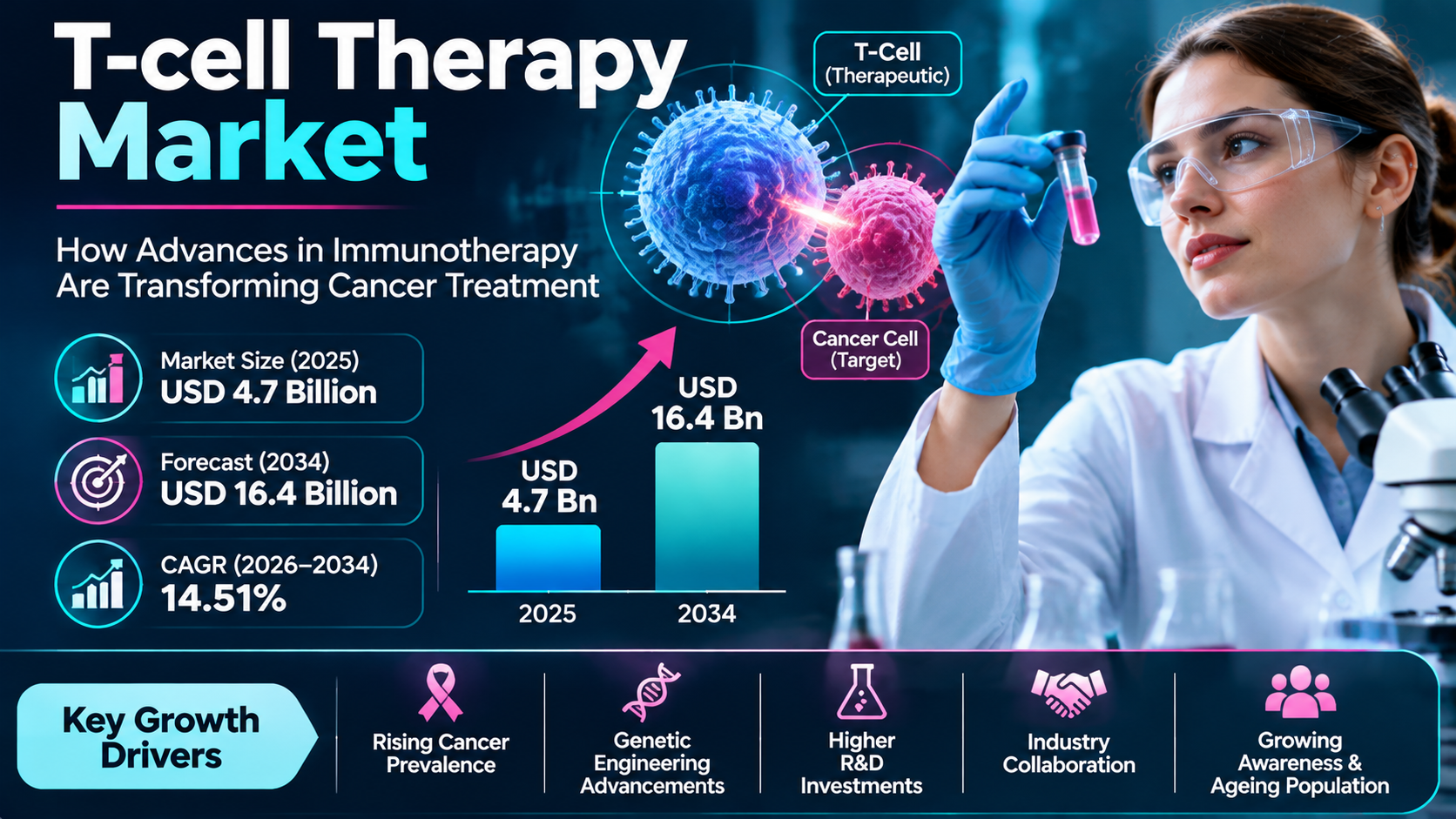
The global T-cell therapy market reached USD 4.7 billion in 2025 and is projected to reach USD 16.4 billion by 2034, exhibiting a CAGR of 14.51% during 2026-2034. Increasing cancer and autoimmune disease prevalence, advancements in genetic engineering, and growing investments in research and development (R&D) are supporting market expansion. As healthcare providers increasingly explore personalized treatment approaches, T-cell therapies are gaining attention for their ability to harness the body's immune system to identify and eliminate diseased cells.
-
Rising prevalence of cancer and autoimmune disorders. The increasing global burden of diseases such as leukemia, lymphoma, myeloma and solid tumors is creating demand for innovative treatment approaches. T-cell therapies offer a targeted approach by using engineered immune cells to recognize and eliminate diseased cells, supporting their growing adoption in oncology and related therapeutic applications.
-
Advancements in genetic engineering. Progress in genetic engineering technologies is enabling researchers to modify T-cells with greater precision. Techniques such as CRISPR-Cas9 are supporting the development of engineered cells with improved specificity and durability, creating opportunities for more personalized and effective treatment approaches.
-
Growing research and development investments. Pharmaceutical companies, biotechnology firms and research institutions are increasing investments in T-cell therapy research. These activities are supporting innovation in target identification, cell engineering techniques and manufacturing processes, helping develop therapies with improved efficacy, safety profiles and scalability.
-
Increasing collaboration across the healthcare ecosystem. Partnerships between academic institutions, pharmaceutical companies and biotechnology firms are facilitating the exchange of expertise and resources. Collaboration with regulatory bodies is also helping streamline approval processes and support the development of innovative therapies.
-
Growing awareness and an ageing population. Expanding awareness among healthcare providers and patients about the potential benefits of T-cell therapies is supporting market interest. At the same time, the growing geriatric population is contributing to demand for advanced immunotherapies and effective treatment options.
What could slow it down: The report highlights the importance of meeting evolving regulatory safety and efficacy standards and mitigating potential risks associated with T-cell therapies. However, it does not provide a quantified breakdown of individual market restraints.
Segment Breakdown
By modality. Research represents the largest segment of the T-cell therapy market, reflecting ongoing innovation and scientific exploration. Academic institutions, pharmaceutical companies and biotechnology firms are working together to improve treatment efficacy, safety and accessibility. The growing demand for personalized medicine is also supporting research activities, as therapies increasingly require optimization according to individual patients' genetic and immune profiles. Commercialized therapies represent the other segment.
By therapy type. CAR T-cell-based therapies dominate the market, followed by T-cell receptor (TCR)-based and tumor-infiltrating lymphocyte (TIL)-based therapies. CAR T-cell therapies offer flexibility in targeting a wide range of cancer antigens and have demonstrated clinical efficacy in certain hematologic malignancies. Extensive research and clinical trials, combined with advancements in genetic engineering, are supporting the development of CAR T-cells with improved specificity, durability and safety profiles.
By indication. Hematologic malignancies represent the largest indication segment, including lymphoma, leukemia and myeloma. These conditions have historically presented significant treatment challenges, creating demand for innovative therapeutic approaches. CAR T-cell therapies can recognize specific surface antigens on malignant cells, supporting targeted treatment strategies. Solid tumors, including melanoma, brain and central nervous system cancers, liver cancer and others, represent another important segment. Other indications are also included in the market analysis.
Want the full segment data and forecasts? Get a free sample of the report.
Regional Outlook
-
North America: The largest regional market, supported by a strong R&D infrastructure, leading pharmaceutical and biotechnology companies, and established academic institutions. Favorable regulatory conditions, substantial investment in biotechnology, a high prevalence of cancer and autoimmune diseases, and an extensive clinical trial network are supporting regional growth.
-
Asia Pacific: The market includes China, Japan, India, South Korea, Australia, Indonesia and other countries. Research activities, healthcare development and growing interest in advanced treatment approaches are important areas covered by the regional analysis.
-
Europe: The report covers Germany, France, the United Kingdom, Italy, Spain, Russia and other markets. Pharmaceutical research, biotechnology development and regulatory activities contribute to the region's position in the global market.
-
Latin America: Brazil, Mexico and other countries form the regional market, with opportunities linked to the development of healthcare and biotechnology capabilities.
-
Middle East and Africa: This region is also included in the market assessment, reflecting its role in the broader global T-cell therapy landscape.
Competitive Landscape
Competition in the T-cell therapy market centres on genetic engineering capabilities, immunology research, therapeutic efficacy, safety profiles and the development of advanced treatment approaches. Pharmaceutical companies, biotechnology firms, research institutions and regulatory bodies all contribute to the industry's development and commercialization.
Collaboration between industry and academia is supporting the development of innovative therapies, while regulatory agencies play an important role in ensuring patient safety and treatment accessibility. Strategic partnerships, research breakthroughs and technological advancements are expected to shape the competitive environment.
Leading companies include Amgen Inc., Aurora Biopharma Inc., bluebird bio Inc., Bristol-Myers Squibb Company, Fate Therapeutics, Gilead Sciences Inc., Merck KGaA, Mustang Bio Inc. (Fortress Biotech Inc.), Novartis AG, Pfizer Inc., Sorrento Therapeutics Inc. and TCR2 Therapeutics.
Latest Industry Moves
-
February 2023: Sorrento Therapeutics, Inc. announced that the U.S. Bankruptcy Court for the Southern District of Texas granted interim approval of the company's USD 75 million debtor-in-possession financing from JMB Capital Partners.
-
May 2023: uBriGene (Boston) Biosciences announced plans to acquire Mustang Bio's Worcester manufacturing facility for up to USD 11 million, entering a strategic manufacturing partnership to support its future pipeline and MB-106.
-
July 2023: Gilead Sciences, Inc. announced that the European Commission approved Trodelvy (sacituzumab govitecan) as a monotherapy for the treatment of adult patients with unresectable or metastatic hormone receptor (HR)-positive disease.
Where the Opportunities Are
The increasing prevalence of cancer and autoimmune disorders presents significant opportunities for T-cell therapy developers. Growing demand for personalized medicine is encouraging pharmaceutical and biotechnology companies to invest in advanced cell engineering technologies and innovative therapeutic approaches.
CAR T-cell therapies offer opportunities through their ability to target a wide range of cancer antigens, particularly in hematologic malignancies. Meanwhile, advancements in TCR-based and TIL-based therapies are expanding research into additional therapeutic possibilities, including solid tumors.
Genetic engineering technologies such as CRISPR-Cas9 are creating further opportunities to improve T-cell specificity and durability. Continued R&D investments, collaborations between academic and commercial organizations, and improvements in manufacturing processes are also supporting the development of therapies with enhanced efficacy, safety and scalability.
Final Take
The global T-cell therapy market is witnessing significant growth, driven by continuous advancements in immunotherapy, increasing investments in cell-based research, and rising demand for personalized cancer treatments. The CAR T-cell therapy market represents a major growth segment, particularly in the treatment of hematologic malignancies, as innovative therapies continue to improve treatment outcomes for patients with complex cancers. Ongoing developments in genetic engineering, cell modification technologies, and therapeutic manufacturing are further expanding the clinical and commercial potential of T-cell-based treatments.
The CAR T-cell therapy market analysis highlights the growing importance of research and development, expanding clinical applications, and improvements in treatment safety and efficacy. North America continues to hold a leading position in the global market, supported by advanced healthcare infrastructure, strong biotechnology research capabilities, substantial R&D investments, and the presence of established industry participants. Furthermore, increasing collaborations between pharmaceutical companies, biotechnology firms, and research institutions are accelerating the development and commercialization of next-generation therapies. Companies prioritizing innovative cell engineering technologies, enhanced safety profiles, manufacturing efficiency, and strategic research partnerships are expected to capitalize on emerging opportunities in the evolving T-cell therapy landscape.
About the Author:
IMARC Group is a leading global market research company providing data-driven insights and expert consulting services to businesses seeking to achieve their strategic objectives. With a multi-disciplinary team of industry experts, IMARC delivers thorough, reliable market intelligence across sectors including Technology and Media, BFSI, Retail, Healthcare, and more.
Media & Sales Contact:
IMARC Group
United States: +1-201-971-6302
India: +91-120-433-0800
United Kingdom: +44-753-714-6104

 English
 Arabic
 French
 Spanish
 Portuguese
 Deutsch
 Turkish
 Dutch
 Italiano
 Russian
 Romaian
 Greek