


7 Silicone Elastomer Trends Reshaping Manufacturing and Product Design
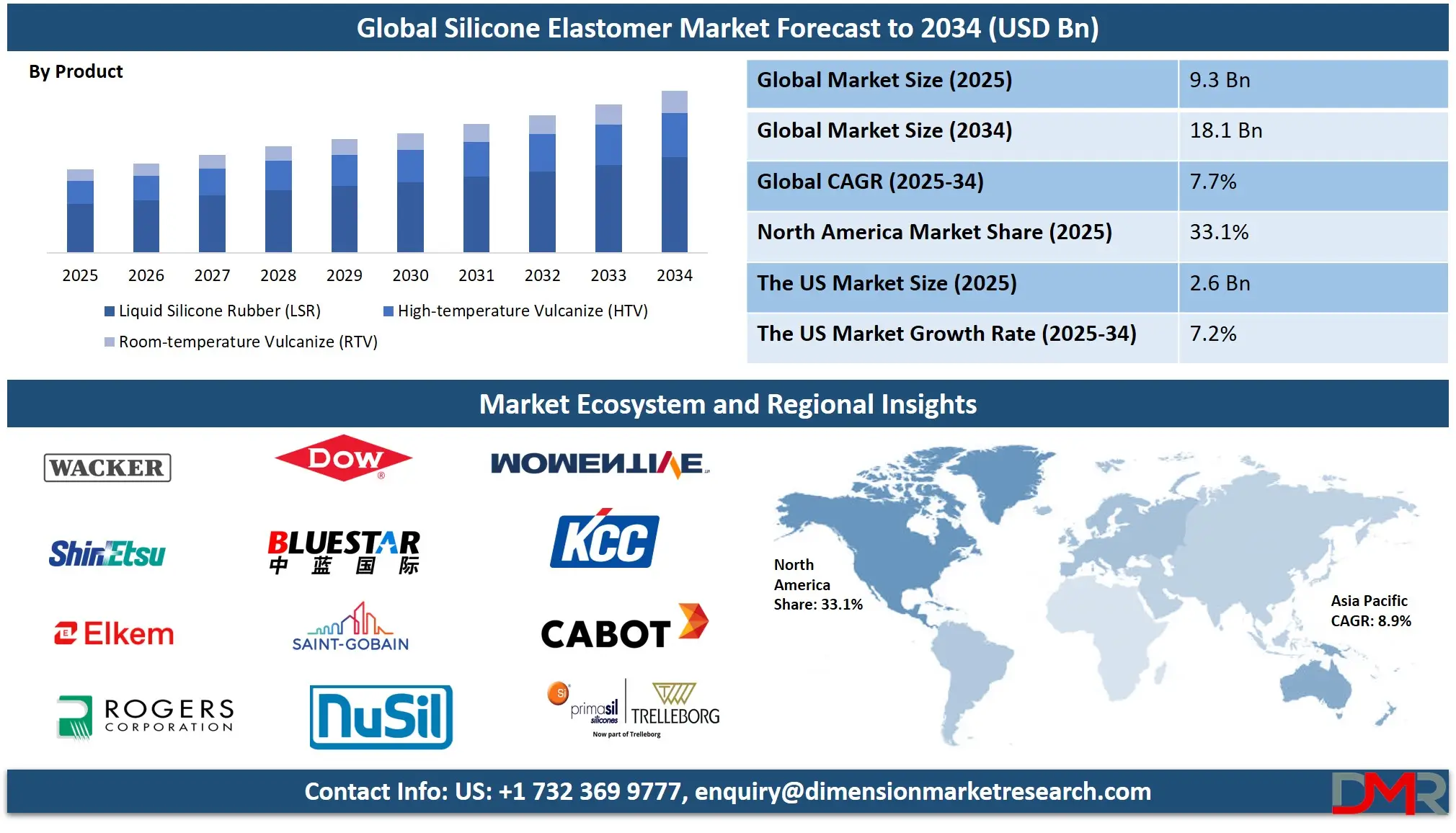
According to Dimension Market Research, the Silicone Elastomer Market is projected to reach USD 9.3 billion in 2025 and expand at a 7.7% CAGR through 2034, reaching approximately USD 18.3 billion according to the market overview. Silicone elastomers are increasingly being adopted because they combine flexibility, durability, heat resistance, chemical resistance, and weatherability across demanding applications.
From automotive components and medical devices to electronics, construction materials, and industrial machinery, silicone elastomers have become an important class of high-performance materials. The market is also evolving as manufacturers focus on sustainability, advanced processing, customization, and new applications such as silicone 3D printing.
Here are seven important trends shaping the future of the silicone elastomer industry.
1. Liquid Silicone Rubber Is Becoming a Manufacturing Favorite
Liquid Silicone Rubber (LSR) is one of the most important product trends in the industry. DMR estimates that LSR will account for approximately 58.9% of silicone elastomer market revenue in 2025, making it the leading product segment.
The popularity of LSR comes from its combination of flexibility, durability, precision, and resistance to extreme temperatures. It can also be processed into complex shapes, making it suitable for highly engineered components.
Healthcare manufacturers use LSR for medical devices, tubing, and other specialized components. Automotive manufacturers use it for seals, gaskets, and other components that must operate reliably under demanding conditions.
The ability to combine precision manufacturing with consistent material performance is likely to keep LSR at the center of silicone elastomer innovation.
2. Sustainable Silicone Materials Are Gaining Attention
Sustainability is becoming an increasingly important consideration for material manufacturers and their customers.
Traditional silicone elastomers offer long service lives, but their environmental impact, disposal, and recycling challenges are encouraging companies to explore alternative solutions. DMR highlights growing interest in eco-friendly, recyclable, and bio-based silicone elastomers.
Manufacturers are increasingly exploring formulations and production processes that can reduce waste and improve material efficiency.
This trend is particularly relevant to automotive, healthcare, construction, and consumer-product manufacturers that are facing greater pressure to improve the environmental performance of their products.
In the coming years, sustainability may become an important differentiator between silicone elastomer suppliers rather than simply a compliance requirement.
3. Silicone 3D Printing Is Expanding Design Possibilities
Additive manufacturing is creating new opportunities for silicone elastomers.
Traditional molding techniques are highly effective for large-scale production, but 3D printing can offer advantages when manufacturers need customized shapes, prototypes, complex geometries, or specialized components.
DMR identifies 3D printing with silicone elastomers as an emerging technological development in the industry.
Silicone 3D printing can be particularly valuable in medical applications where customized structures may be required. It can also support product development and prototyping by allowing engineers to test designs before committing to conventional tooling.
Recent developments in silicone formulations specifically designed for 3D printing demonstrate the industry's movement toward more digitally enabled manufacturing.
4. Medical Applications Are Creating High-Value Opportunities
Healthcare is one of the most important application areas for silicone elastomers because of their flexibility, durability, and biocompatibility.
Silicone elastomers can be used in medical implants, tubing, wearable devices, prosthetic components, and other healthcare applications. Their ability to tolerate demanding environments while maintaining flexibility makes them suitable for specialized medical products.
The expansion of medical-device manufacturing and wearable healthcare technologies is creating additional opportunities.
Another important factor is customization. Medical applications frequently require precise dimensions, specialized material properties, and application-specific designs. This creates opportunities for suppliers that can provide customized grades rather than standardized materials alone.
5. Electric Vehicles Are Expanding Silicone Elastomer Applications
The transformation of the automotive industry is opening new opportunities for silicone elastomer manufacturers.
Silicone materials have traditionally been used in automotive gaskets, seals, hoses, and other components. However, the growth of electric vehicles is expanding potential applications toward battery insulation, thermal management, electrical protection, and high-performance sealing.
EV systems require materials capable of operating reliably around electrical components and under varying temperature conditions. Silicone elastomers can provide insulation, flexibility, and resistance to heat and environmental exposure.
As EV production increases, suppliers that develop materials specifically for electric powertrains and battery systems may gain new growth opportunities.
This also creates demand for specialized formulations with enhanced thermal, electrical, and mechanical performance.
Download Sample PDF of the Report: https://dimensionmarketresearch.com/request-sample/silicone-elastomer-market/
6. Advanced Molding Technologies Are Improving Production Efficiency
The silicone elastomer industry is not only changing through new materials; manufacturing processes are evolving as well.
Liquid Injection Molding (LIM) is expected to represent approximately 36.7% of market revenue in 2025, according to DMR. LIM enables high-volume production of precise silicone components while supporting consistent quality and reduced material waste.
The process is particularly relevant to automotive, healthcare, and electronics manufacturers that require large numbers of highly consistent components.
At the same time, compression molding is projected to experience strong growth because it can provide a cost-effective approach for manufacturing high-strength silicone components.
As manufacturers focus on automation, productivity, quality control, and cost reduction, advanced molding technologies are expected to become increasingly important.
7. Construction Demand Is Supporting Long-Term Market Growth
Construction remains one of the most important end-use markets for silicone elastomers. DMR expects the construction segment to account for approximately 41.1% of market revenue in 2025.
Silicone elastomers are used in construction for:
- Window and façade seals
- Expansion joints
- Weatherproofing
- Adhesives
- Coatings
- Insulation applications
Their resistance to moisture, UV exposure, temperature fluctuations, and weather conditions makes them useful for both residential and commercial construction.
The growth of infrastructure development, smart buildings, green construction, and energy-efficient structures is creating further demand for high-performance sealing materials.
As building owners place greater emphasis on durability and long-term performance, silicone-based materials can benefit from the shift toward higher-quality construction solutions.
Asia Pacific Remains the Key Regional Growth Center
Asia Pacific is expected to hold the largest share of the Silicone Elastomer Market, accounting for approximately 48.2% of revenue in 2025.
Rapid industrialization, urbanization, infrastructure development, electronics manufacturing, automotive production, and healthcare expansion are supporting regional demand.
China, India, Japan, South Korea, and other Asian markets have strong manufacturing ecosystems that consume silicone elastomers across multiple industries.
The region's combination of manufacturing capacity and growing domestic consumption makes it an important market for both established suppliers and companies looking to expand their silicone-material businesses.
The Middle East and Africa also offer emerging opportunities, particularly as infrastructure and industrial projects increase.
What These Trends Mean for Silicone Elastomer Manufacturers
The silicone elastomer industry is moving toward more specialized, efficient, and application-specific solutions.
Manufacturers can no longer compete only on basic material availability. Customers increasingly want products that deliver a combination of:
- High-performance material properties
- Manufacturing efficiency
- Application-specific customization
- Regulatory compliance
- Sustainability
- Long-term reliability
This creates opportunities for companies that invest in research and development, advanced processing technologies, sustainable formulations, and industry-specific product solutions.
Competitive Landscape
The market includes a mixture of large chemical companies, silicone specialists, and regional manufacturers. Major companies identified by Dimension Market Research include Dow Inc., Wacker Chemie AG, Momentive Performance Materials Inc., Shin-Etsu Chemical Co., Ltd., China National Bluestar, KCC Corporation, Elkem ASA, Saint-Gobain, Cabot Corporation, Rogers Corporation, Nusil Technology, Primasil Silicones, Wynca Group, Hoshine Silicon Industry, Dongyue Group, SIGMA SOFT, ContiTech, TechSil, The Rubber Company, and Silchem.
Competitive strategies include product innovation, R&D investments, capacity expansion, partnerships, acquisitions, and development of specialized silicone grades.
Companies that can combine technical performance with cost efficiency and sustainability are likely to be better positioned as customer requirements become more demanding.
Why Silicone Elastomer Market Intelligence Matters
For manufacturers, investors, suppliers, and downstream industries, understanding these trends can help identify where future demand is likely to develop.
The most attractive opportunities may emerge at the intersection of advanced materials, EV manufacturing, healthcare technology, smart construction, electronics, and sustainable production.
Businesses evaluating market entry, capacity expansion, product development, partnerships, or investment decisions can use detailed market research to understand segment performance, regional demand, competitive positioning, and emerging opportunities.
For deeper analysis, explore the Silicone Elastomer Market Report from Dimension Market Research, which covers product categories, manufacturing processes, end-user industries, regional markets, competitive landscape, market dynamics, and forecasts.
Conclusion
The Silicone Elastomer Market is evolving from a conventional materials industry into a technology-driven market supporting some of the world's fastest-changing industries.
LSR adoption, sustainable materials, silicone 3D printing, medical applications, EV technologies, advanced molding, and construction demand are creating multiple pathways for future growth.
With the market expected to expand significantly through 2034, companies that focus on innovation, customization, manufacturing efficiency, and sustainable material development can position themselves to capture emerging opportunities.
For businesses operating across the silicone value chain, tracking these seven trends can provide an important foundation for product strategy, investment planning, and long-term market positioning.
- Memes & Cultura da Comunidade
- Artigos e Análises
- Pessoal
- Oportunidade
- Projeto
- Conhecimento
- Dúvidas & Pedidos de Ajuda
- Reflexões & Opiniões
- Tendências
- Giochi
- Lançamentos & Anúncios
- Saúde & Bem Estar
- Eventos & Convites
- Conteúdo Técnico
- Entretenimento
- Networking
- Festas & Festivais
- Religião
- Iniciativas de Impacto
 Italiano
 English
 Arabic
 French
 Spanish
 Portuguese
 Deutsch
 Turkish
 Dutch
 Russian
 Romaian
 Portuguese (Brazil)
 Greek