


EU Thermal Power Modernization: Where Retrofit Demand Is Growing
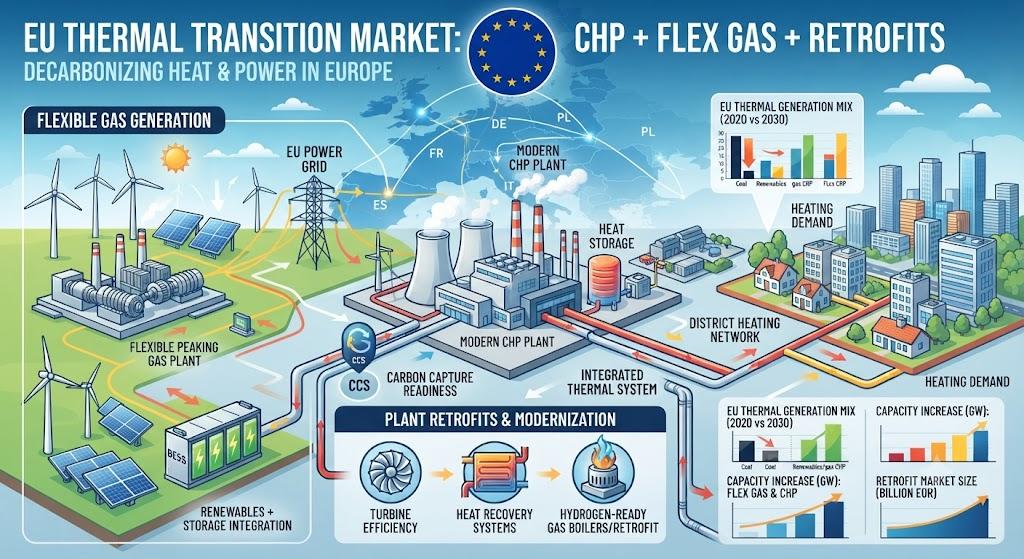
Key Trends Shaping Europe’s CHP and Flexible Gas Market
Europe’s thermal power environment is evolving from a relatively predictable generation model toward one that emphasizes flexibility, efficiency, resilience, and integration with renewable resources. This transformation is creating new priorities for combined heat and power facilities, gas-fired generation, and aging thermal plants. Rather than treating these assets as isolated technologies, market participants increasingly evaluate them as components of a changing energy system.
One important development is the modernization of CHP. Industrial and district heating users continue to require dependable thermal energy, but operators are seeking better efficiency and greater operational control. Modern CHP projects can combine high-performance engines or turbines with heat recovery, thermal storage, digital controls, and improved automation. These features can help plants respond to electricity-market conditions without compromising essential heat delivery.
Flexible gas generation is another major area of interest. Solar and wind output can change quickly, increasing the need for resources capable of adjusting production. Gas engines and turbines can provide dispatchable capacity, particularly when they are optimized for rapid starts, ramping, cycling, and partial-load operation. Existing plants may require control-system upgrades or equipment modifications to achieve these capabilities efficiently.
Retrofit activity is becoming more strategic as well. Aging thermal plants may contain valuable grid connections, developed sites, auxiliary systems, and experienced operating teams. Replacing the entire facility can be expensive and time-consuming, so owners may evaluate targeted upgrades instead. Modernization can include turbines, generators, heat exchangers, boilers, cooling systems, transformers, switchgear, emissions equipment, and plant-control platforms.
A further trend is the growing use of digital technologies. Industrial internet systems, remote monitoring, predictive analytics, and automated optimization can improve visibility across thermal assets. Operators can monitor equipment condition, compare performance against expected benchmarks, and identify maintenance requirements before failures occur. Dispatch software can combine electricity prices, fuel costs, weather forecasts, heat demand, and technical constraints to support operating decisions.
Integration with other energy technologies is also becoming more important. CHP plants can work alongside thermal storage, heat pumps, renewable heat, batteries, and on-site solar. Flexible gas units can complement renewable generation and participate in balancing services. Retrofit programs can therefore be designed around broader energy-system objectives rather than a single machine or generator.
The EU Thermal Transition (CHP + Flex Gas + Retrofits) Market Trends also reflect growing attention to lifecycle economics. Asset owners are increasingly considering total operating costs, maintenance requirements, fuel exposure, emissions obligations, outage risks, and potential revenue from ancillary services. This can favor technologies that deliver reliable performance across multiple operating conditions rather than those optimized for one narrow duty cycle.
Environmental performance remains a critical consideration. Gas-fired generation can face pressure from emissions policies, while CHP projects may need to demonstrate efficient use of fuel and compatibility with evolving energy strategies. Retrofit decisions can therefore include emissions-control upgrades, efficiency improvements, fuel flexibility, and monitoring systems. Future-ready projects may also evaluate pathways for lower-carbon fuels where technically and commercially practical.
Supply-chain trends are changing alongside project requirements. Customers may increasingly prefer suppliers capable of delivering engineering, equipment, software, commissioning, and maintenance through coordinated packages. Long-term service agreements can provide additional support as plants operate under more demanding cycling conditions. Specialist expertise in aging equipment can also become valuable as operators seek to extend asset life.
Market conditions will remain different across countries and applications. Industrial CHP, district heating, merchant generation, and utility assets have distinct revenue structures and operating requirements. Consequently, project developers must assess local regulation, grid conditions, fuel availability, heat demand, and market design before selecting a technology pathway.
Europe’s thermal transition is a multi-technology modernization cycle. CHP improvements, flexible gas operation, targeted retrofits, and digital optimization can help assets remain useful.
- Memes & Cultura da Comunidade
- Artigos e Análises
- Pessoal
- Oportunidade
- Projeto
- Conhecimento
- Dúvidas & Pedidos de Ajuda
- Reflexões & Opiniões
- Tendências
- Παιχνίδια
- Lançamentos & Anúncios
- Saúde & Bem Estar
- Eventos & Convites
- Conteúdo Técnico
- Entretenimento
- Networking
- Festas & Festivais
- Religião
- Iniciativas de Impacto
 Greek
Greek
 English
 Arabic
 French
 Spanish
 Portuguese
 Deutsch
 Turkish
 Dutch
Dutch
 Italiano
 Russian
 Romaian
 Portuguese (Brazil)