


United States Smoothie Market Size to Hit USD 10,014.6 Million in 2034 | Grow CAGR by 3.82%
IMARC Group has recently released a new research study titled "United States Smoothie Market Size, Share, Trends and Forecast by Product, Distribution Channel, Packaging Material, Consumption Pattern, and Region, 2026-2034", offering a detailed analysis of the market drivers, segmentation, growth opportunities, trends, and competitive landscape to understand the current and future market scenarios.
United States Smoothie Market Size & Share 2026-2034
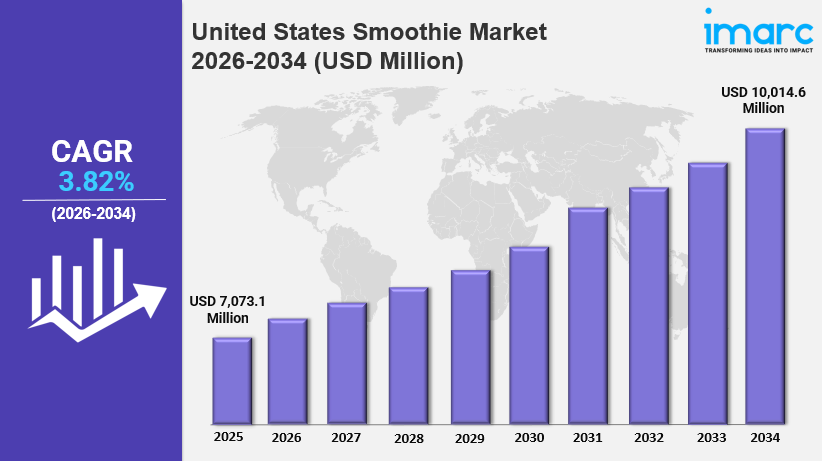
The United States smoothie market size reached USD 7,073.1 Million in 2025 and is projected to reach USD 10,014.6 Million by 2034, expanding at a CAGR of 3.82% during 2026-2034. In 2026, the market continues to gain momentum, propelled by rising consumer focus on health and wellness, increasing demand for functional beverages, and a growing preference for meal replacements.
Growth in 2026 is further reinforced by busy lifestyles and interest in convenient, nutrient-dense products, along with the rising popularity of plant-based diets, protein-rich options, and clean-label ingredients. These dynamics are expected to strengthen the United States smoothie market share throughout the forecast period.
Key Market Statistics at a Glance
- Base Year: 2025
- Historical Years: 2020-2025
- Forecast Period: 2026-2034
- Market Size (2025): USD 7,073.1 Million
- Projected Market Size (2034): USD 10,014.6 Million
- Growth Rate: CAGR of 3.82% (2026-2034)
- Leading Product (2025): Fruit-Based (59.4% share)
- Leading Distribution Channel (2025): Restaurants and Smoothie Bars (67% share)
- Leading Packaging Material (2025): Plastic (60.7% share)
- Leading Consumption Pattern (2025): At Home (65% share)
- Leading Region (2025): West (40.3% share)
Explore Opportunities in the United States Smoothie Market: Download the IMARC Sample Report: https://www.imarcgroup.com/united-states-smoothie-market/requestsample
Key Growth Drivers and Trends in the United States Smoothie Market
Growth in the United States smoothie market is being driven by the health and wellness trend. Consumers see smoothies, packed with fruits, vegetables, and superfoods, as a convenient way to support a healthy lifestyle, a view backed by the Dietary Guidelines for Americans' call for higher fruit and vegetable intake. According to the USDA, 90% of Americans fall short of the recommended daily consumption of fruits and vegetables, which points to room for smoothies as an easy way to close the gap. Demand for functional smoothies enriched with protein, vitamins, and minerals is rising as consumers seek benefits such as better digestion and stronger immunity.
One of the leading United States smoothie market trends is the growing demand for organic and natural ingredients. As awareness of synthetic additives and preservatives grows, consumers are choosing smoothies made with organic and natural components, and are willing to pay more for purity and sustainability. The USDA reports that the organic industry has grown into a USD 63 billion sector, with fruits and vegetables the largest segment, and its Organic Market Development Grant program designates up to USD 85 Million to strengthen key markets.
Another key factor supporting United States smoothie market growth is innovation in flavors and varieties, alongside convenience-led distribution. Consumers are seeking distinctive and exotic tastes, from tropical fruit blends to combinations with vegetables, herbs, and spices, and the United States imported tropical fruits valued at USD 5.73 Billion in 2024 according to the Observatory of Economic Complexity. Single-serve packaging, ready-to-drink bottled smoothies, grab-and-go options, online grocery, delivery apps, and direct-to-consumer subscription kits are widening access. Brands and smoothie shops are also offering customizable choices, letting consumers pick the base, ingredients, and functional add-ins.
Speak to an Analyst: https://www.imarcgroup.com/request?type=report&id=2926&flag=C
United States Smoothie Industry Segmentation Insights
Breakup by Product:
- Dairy-Based: Smoothies made with dairy ingredients such as milk, yogurt, or kefir, valued for creaminess and protein content. Lifeway Foods' November 2024 Probiotic Smoothie + Collagen is an example of a kefir-based launch.
- Fruit-Based: The largest segment with a 59.4% share in 2025, supported by natural sweetness, vitamins, minerals, antioxidants, and fiber, wide consumer appeal, clean-label demand, and a diverse range of single-fruit, mixed-fruit, seasonal, and exotic flavors.
Breakup by Distribution Channel:
- Restaurants and Smoothie Bars: The leading channel with a 67% share in 2025, offering freshly made, customizable drinks, high foot traffic near gyms, workplaces, and retail centers, and digital ordering, loyalty programs, and delivery options.
- Supermarkets and Hypermarkets: Provide ready-to-drink bottled smoothies, frozen options, and ingredients for home preparation in one convenient location.
- Convenience Stores: Serve grab-and-go demand with single-serve smoothies for on-the-go nutrition.
- Others: Includes additional channels such as online grocery services, delivery apps, and direct-to-consumer subscriptions.
Breakup by Packaging Material:
- Plastic: The largest segment with a 60.7% share in 2025, favored for being cost-effective, lightweight, durable, easy to seal, and transparent, with recyclable and biodegradable alternatives addressing environmental concerns.
- Paper: Used for cups and cartons, supported by growing interest in eco-friendly packaging.
- Glass: Used for premium and cold-pressed bottled smoothies, valued for its perception of purity and quality.
- Others: Covers additional packaging formats used for smoothies.
Breakup by Consumption Pattern:
- Out of Home: Smoothies purchased and consumed away from home at smoothie bars, cafes, restaurants, and convenience outlets, appealing to busy, on-the-go consumers.
- At Home: The dominant pattern with a 65% share in 2025, supported by health focus, convenience, and affordability, with home blenders, pre-portioned packages, and frozen mixes making it easy to control ingredients, portions, and sugar levels.
Breakup by Region:
- Northeast: One of the four regional markets covered, with demand supported by dense urban populations and health-conscious consumers.
- Midwest: One of the four regional markets covered, with demand supported by growing retail availability and rising interest in healthy, convenient beverages.
- South: One of the four regional markets covered, with demand supported by a large population base and expanding smoothie chains and retail presence.
- West: The leading region with a 40.3% share in 2025, driven by a strong health and wellness culture, a large base of health-focused consumers, a dense presence of smoothie shops and health food stores, and a climate that supports year-round cold beverage consumption.
Key Challenges and Growth Opportunities in the United States Smoothie Market
The United States smoothie market faces the challenge of maintaining product quality while staying competitive on price. Ingredients such as fresh fruit, nuts, and plant-based add-ins are perishable and costly, and a crowded field of large and niche players creates pressure to cut costs. Some consumers also remain skeptical of health claims, especially when products contain added sugars or artificial ingredients, so brands must balance taste, health, and affordability while managing supply chains and sustainability expectations.
Despite this, the market offers considerable growth opportunities driven by demand for health-conscious and functional beverages that deliver benefits such as energy, digestion, and immunity support. Innovative blends featuring superfoods, adaptogens, and plant proteins, rising interest in clean-label, vegan, and allergen-free products, and online and direct-to-consumer models offering personalization and delivery are expected to create substantial opportunities for long-term growth in the United States smoothie market.
Competitive Landscape
The United States smoothie market is competitive, with large and niche players focused on product innovation, expanding ranges to include organic, plant-based, and protein-rich options, and investing in cold-pressed and low-sugar offerings. Companies are using digital platforms and direct-to-consumer channels to broaden reach, partnering with gyms, cafes, and health food stores for distribution, and prioritizing eco-friendly packaging and sourcing. In 2025, Grupo Jumex announced the U.S. relaunch of Odwalla with a new line of juices and smoothies made with natural ingredients and no added sugar.
Recent developments include Smoothie King ending 2024 with 1,200 U.S. locations after opening 84 new stores and planning 105 openings in 2025, and Tropical Smoothie Cafe opening 161 new cafes in the prior year to surpass 1,500 locations and signing 247 new franchise agreements. In October 2024, Smoothie King launched a GLP-1 Support Menu of high-protein, no-added-sugar smoothies, and in July 2024 Blender Bites launched its organic, plant-based Superberry Sport 1-Step Smoothie in 151 locations across 16 states.
Author IMARC Group
IMARC Group is a leading global market research company providing data-driven insights and expert consulting services to businesses seeking to achieve their strategic objectives. With a multidisciplinary team of industry experts, IMARC delivers reliable market intelligence across sectors including Chemicals and Materials, Healthcare, Technology, Agriculture, and Retail.
Contact Us:
IMARC Group
Email: sales@imarcgroup.com
United States: +1-201-971-6302
- Memes & Cultura da Comunidade
- Artigos e Análises
- Pessoal
- Oportunidade
- Projeto
- Conhecimento
- Dúvidas & Pedidos de Ajuda
- Reflexões & Opiniões
- Tendências
- Giochi
- Lançamentos & Anúncios
- Saúde & Bem Estar
- Eventos & Convites
- Conteúdo Técnico
- Entretenimento
- Networking
- Festas & Festivais
- Religião
- Iniciativas de Impacto
 Italiano
 English
 Arabic
 French
 Spanish
 Portuguese
 Deutsch
 Turkish
 Dutch
 Russian
 Romaian
 Portuguese (Brazil)
 Greek