


Canada Edtech Market Size, Share | Growth Analysis Report 2034
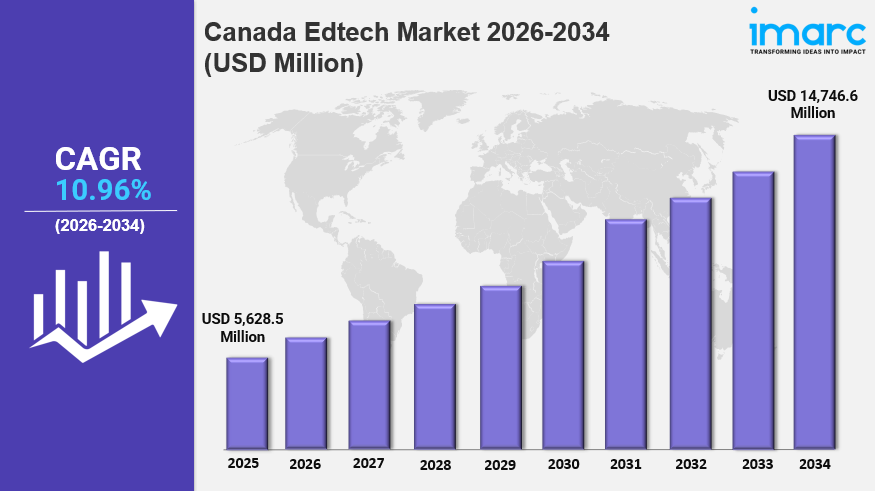
IMARC Group has recently released a new research study titled "Canada Edtech Market Size, Share, Trends, and Forecast by Sector, Type, Deployment Mode, End User, and Region, 2026-2034", offering a detailed analysis of the market drivers, segmentation, growth opportunities, trends, and competitive landscape to understand the current and future market scenarios.
Canada Edtech Market Size & Share 2026-2034
The Canada edtech market size was valued at USD 5,628.5 Million in 2025 and is projected to reach USD 14,746.6 Million by 2034, exhibiting a CAGR of 10.96% during 2026-2034. The market is driven by rising demand for AI-powered personalized learning, as schools and corporations adopt adaptive platforms for real-time analytics and tailored instruction, along with the growing need for workforce upskilling.
Growth is further reinforced by the rising popularity of micro-credentials supported by employer preferences for skill-based certifications, government-funded upskilling initiatives, advancing edtech innovations, and high digital literacy. These dynamics are expected to strengthen the Canada edtech market share throughout the forecast period.
Key Market Statistics at a Glance
- Base Year: 2025
- Historical Years: 2020-2025
- Forecast Period: 2026-2034
- Market Size (2025): USD 5,628.5 Million
- Projected Market Size (2034): USD 14,746.6 Million
- Growth Rate: CAGR of 10.96% (2026-2034)
Explore Opportunities in the Canada Edtech Market: Download the IMARC Sample Report: https://www.imarcgroup.com/canada-edtech-market/requestsample
Key Growth Drivers and Trends in the Canada Edtech Market
A leading trend in the Canada edtech market is the increasing adoption of AI-powered learning tools, driven by the need for personalized and adaptive education. Schools, universities, and corporate training programs are integrating AI-driven platforms that offer customized learning experiences, real-time feedback, and predictive analytics, helping educators identify student weaknesses, recommend tailored content, and improve engagement through interactive modules. The rise of generative AI is also being leveraged for automated essay grading, virtual tutoring, and language learning applications, supported by governmental programs that encourage STEM education and innovation in educational technologies.
High digital literacy is a strong enabler of demand. As of 2025, Canada has 38 million internet users, a penetration rate of 95.2%, while active social media users number 31.7 million, representing 79.4% of the population. The growth in the use of digital platforms reflects the rising need for educational technology solutions to support the requirements of Canada's more networked and technologically skilled learners.
Another key factor supporting Canada edtech market growth is the growth of micro-credentials and upskilling platforms catering to professionals and lifelong learners. Canadians are turning to short, flexible courses offered by platforms such as Coursera, Udemy, and LinkedIn Learning, while universities and colleges partner with edtech firms to provide stackable certifications in fields such as data science, cybersecurity, and digital marketing. This aligns with employers' growing preference for skill-based hiring over traditional degrees. Government-backed programs such as the Education and Training Benefit (ETB) further encourage upskilling by offering funding toward both full-degree programs and shorter-term education such as business boot camps and workshops. As remote and hybrid work models persist, demand for bite-sized, on-demand learning is expected to keep rising.
Speak to an Analyst: https://www.imarcgroup.com/request?type=report&id=37352&flag=C
Canada Edtech Market Industry Segmentation Insights
Breakup by Sector:
- Preschool: Early childhood learning solutions, including interactive apps, digital content, and play-based learning tools that support foundational literacy and numeracy skills.
- K-12: Digital classroom tools, adaptive learning platforms, and AI-driven instruction for primary and secondary schools, supported by expanding adoption across school districts.
- Higher Education: Platforms used by universities and colleges for online and hybrid delivery, analytics, and stackable certifications in partnership with edtech firms.
- Others: Includes other education sectors such as vocational, professional, and corporate training.
Breakup by Type:
- Hardware: Devices and equipment used in digital learning environments, such as interactive displays, tablets, and laptops.
- Software: Learning management systems, adaptive learning platforms, and AI-based tutoring and assessment tools.
- Content: Digital courses, e-learning modules, and micro-credential programs delivered through online platforms.
Breakup by Deployment Mode:
- Cloud-based: Scalable, remotely accessible platforms that support real-time analytics, remote and hybrid learning, and rapid content updates.
- On-premises: Solutions hosted on an institution's own infrastructure, preferred where greater control over data and systems is required.
Breakup by End User:
- Individual Learners: Professionals and lifelong learners using online upskilling platforms and short, flexible courses to acquire new skills.
- Institutes: Schools, colleges, and universities adopting digital platforms to personalize instruction and improve engagement.
- Enterprises: Corporations using adaptive learning platforms and training programs for workforce upskilling and reskilling.
Breakup by Region:
- Ontario: One of the major regional markets covered in the report.
- Quebec: One of the major regional markets covered in the report.
- Alberta: One of the major regional markets covered in the report.
- British Columbia: One of the major regional markets covered in the report.
- Others: Includes the remaining provinces and territories.
Key Challenges and Growth Opportunities in the Canada Edtech Market
The Canada edtech market must balance rapid technology adoption with the need to integrate new tools into existing school, college, and corporate training environments, while keeping pace with evolving skill requirements and shifting job market demands.
Despite these challenges, the market offers considerable growth opportunities driven by AI-powered personalized learning, the expansion of micro-credentials and online upskilling platforms, government-backed funding for education and training, high internet and social media penetration, and persistent remote and hybrid work models that sustain demand for on-demand learning.
Competitive Landscape
The Canada edtech market includes technology providers, learning platforms, and institutional partners working to deliver adaptive, AI-driven, and skills-focused learning. In October 2024, Carnegie Learning opened its new Canadian headquarters in St. John's, Newfoundland, to promote the development of its AI-driven educational technology for K-12 schools. The IMARC report provides a comprehensive analysis of the competitive landscape, covering market structure, key player positioning, top winning strategies, competitive dashboard, and company evaluation quadrant, along with detailed profiles of all major companies.
Author IMARC Group
IMARC Group is a leading global market research company providing data-driven insights and expert consulting services to businesses seeking to achieve their strategic objectives. With a multidisciplinary team of industry experts, IMARC delivers reliable market intelligence across sectors including Chemicals and Materials, Healthcare, Technology, Agriculture, and Retail.
Contact Us:
IMARC Group
Email: sales@imarcgroup.com
United States: +1-201-971-6302
- Memes & Cultura da Comunidade
- Artigos e Análises
- Pessoal
- Oportunidade
- Projeto
- Conhecimento
- Dúvidas & Pedidos de Ajuda
- Reflexões & Opiniões
- Tendências
- Jocuri
- Lançamentos & Anúncios
- Saúde & Bem Estar
- Eventos & Convites
- Conteúdo Técnico
- Entretenimento
- Networking
- Festas & Festivais
- Religião
- Iniciativas de Impacto
 Romaian
 English
 Arabic
 French
 Spanish
 Portuguese
 Deutsch
 Turkish
 Dutch
 Italiano
 Russian
 Portuguese (Brazil)
 Greek