


Europe SMR Market Outlook: Understanding Nuclear Energy's Next Growth Phase
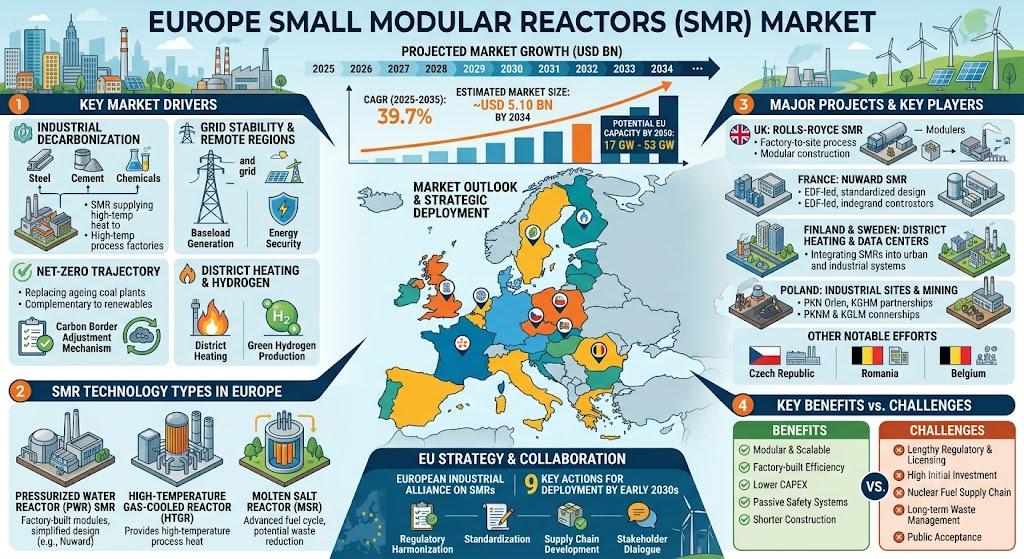
Europe’s SMR Supply Chain Creates Opportunities Beyond Reactor Design
Small modular reactor development is often discussed through the performance of reactor designs and the ambitions of technology developers. Yet a commercial nuclear programme depends on a much wider industrial ecosystem. Components must meet demanding quality standards, manufacturing processes require traceability, and engineering teams must coordinate complex interfaces. For Europe, the readiness of this supply chain could determine how quickly early projects progress and whether later units achieve repeatable delivery.
The Europe Small Modular Reactors Market Trends point toward growing attention on industrial capability. Governments and developers are considering how to expand qualified manufacturing, develop specialist skills and coordinate suppliers across borders. These activities may create business opportunities before large-scale reactor construction begins, particularly for firms able to demonstrate nuclear-grade quality systems and dependable delivery performance. Potential suppliers include manufacturers of pressure-boundary components, valves, pumps, heat exchangers, electrical equipment, instrumentation, control systems and specialist materials.
Engineering companies may support design assurance, safety analysis, site integration and commissioning. Digital providers can contribute configuration management, documentation control, cybersecurity and quality records. The opportunity is broad, but entry requirements are demanding. Nuclear procurement places a premium on evidence, repeatability and long-term accountability.
Qualification is a critical distinction between ordinary industrial capacity and nuclear-ready capacity. Suppliers may need to demonstrate material provenance, manufacturing controls, inspection procedures, non-conformance management and rigorous documentation. A company with available factory space may still require substantial investment to meet the required standards. Early engagement with developers and tier-one contractors can help suppliers understand specifications, forecast demand and decide whether qualification costs are commercially justified.
Manufacturing bottlenecks can influence project schedules well before construction reaches the site. Long-lead components may require specialised facilities, scarce materials or sequential inspections. If procurement begins after design decisions are fixed, delays can become difficult to recover. Developers should identify critical components early, map alternative suppliers and coordinate design maturity with manufacturing readiness.
This approach reduces the risk that a project’s schedule is driven by an overlooked component rather than visible construction activity. Fleet procurement could strengthen the supply-chain case. Repeated orders using a stable design may allow manufacturers to invest in tooling, workforce training and production capacity. Learning effects can improve productivity and reduce delivery variation, but only when orders are sufficiently credible and specifications remain consistent.
A collection of unrelated demonstration projects may not create the same industrial benefits as a coordinated programme with clear demand visibility. Europe’s established nuclear industry provides a foundation through utilities, engineering contractors, research institutions and component manufacturers. However, an SMR programme may require new production methods and different supplier relationships. Cross-border collaboration can broaden the supplier base, while national industrial policies may seek to retain strategic capabilities locally.
The challenge is to balance resilience with efficiency: excessive localisation can raise costs, but overreliance on a narrow supplier pool can create schedule exposure. Workforce availability is another constraint. Programmes will need nuclear engineers, welders, quality inspectors, project controls specialists, commissioning personnel and regulators with relevant expertise. Training takes time, and several projects advancing together could compete for the same people.
Partnerships between industry, universities and technical colleges can help build capacity. Retaining experienced professionals and transferring knowledge to new entrants will be as important as recruiting additional staff. Companies assessing entry should track funded projects, supplier prequalification, component specifications, manufacturing investment and procurement schedules. Suppliers that build qualified capacity, maintain traceable processes and deliver consistently can become valuable partners across multiple programmes. Their opportunity will expand as projects move from design studies into procurement and construction. Preparation today can help create the industrial depth needed for a resilient, competitive European modular nuclear ecosystem, with stronger cross-border capabilities regionally.
- Memes & Cultura da Comunidade
- Artigos e Análises
- Pessoal
- Oportunidade
- Projeto
- Conhecimento
- Dúvidas & Pedidos de Ajuda
- Reflexões & Opiniões
- Tendências
- Jeux
- Lançamentos & Anúncios
- Saúde & Bem Estar
- Eventos & Convites
- Conteúdo Técnico
- Entretenimento
- Networking
- Festas & Festivais
- Religião
- Iniciativas de Impacto
 French
 English
 Arabic
 Spanish
 Portuguese
 Deutsch
 Turkish
 Dutch
 Italiano
 Russian
 Romaian
 Portuguese (Brazil)
 Greek